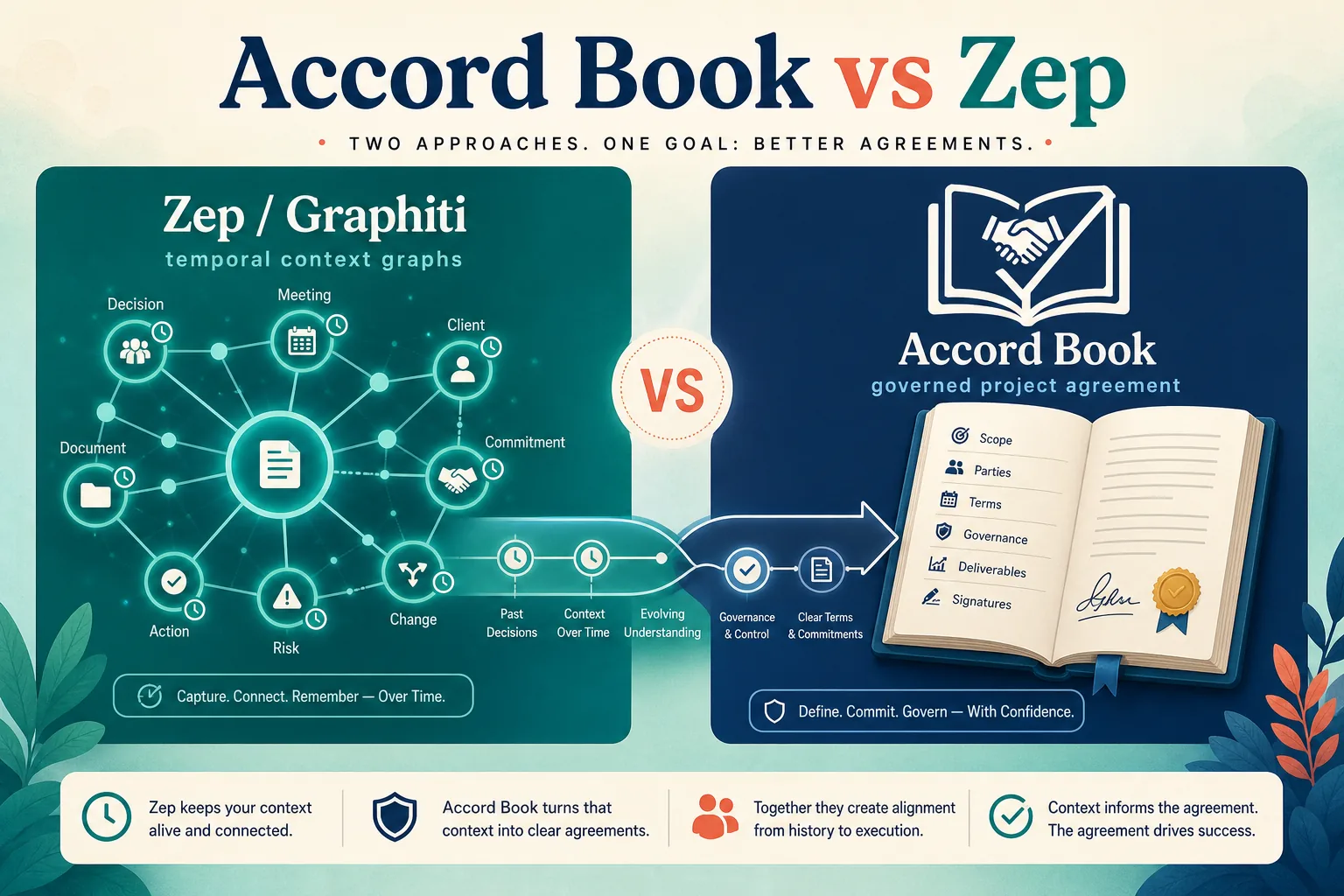
Among agent-memory products, Zep is the closest technical cousin to what Accord Book cares about: entities, facts, time, and provenance. The buyers still diverge. Zep sells agent memory infrastructure. Accord Book sells a living project agreement for a small agency.
What Zep (and Graphiti) are
Zep positions itself as enterprise agent memory built on context graphs: ingest chat and business data, construct a graph, retrieve token-efficient context. Their public site emphasizes validity windows (old facts invalidated when the world changes), provenance back to source episodes, governance (access, retention, audit), and low retrieval latency. Deployment options include managed cloud, BYOK keys, and bring-your-own-cloud.
The open-source engine behind much of this lineage is Graphiti — “real-time knowledge graphs for AI Agents.” Treat Graphiti as the library you can self-host and Zep as the managed / enterprise product on top. Docs and quickstarts: help.getzep.com.
Their best case: a production agent that must know what is true now about a customer, account, or domain — and what was true last March — without stuffing the whole history into the prompt.
Where Zep is strong
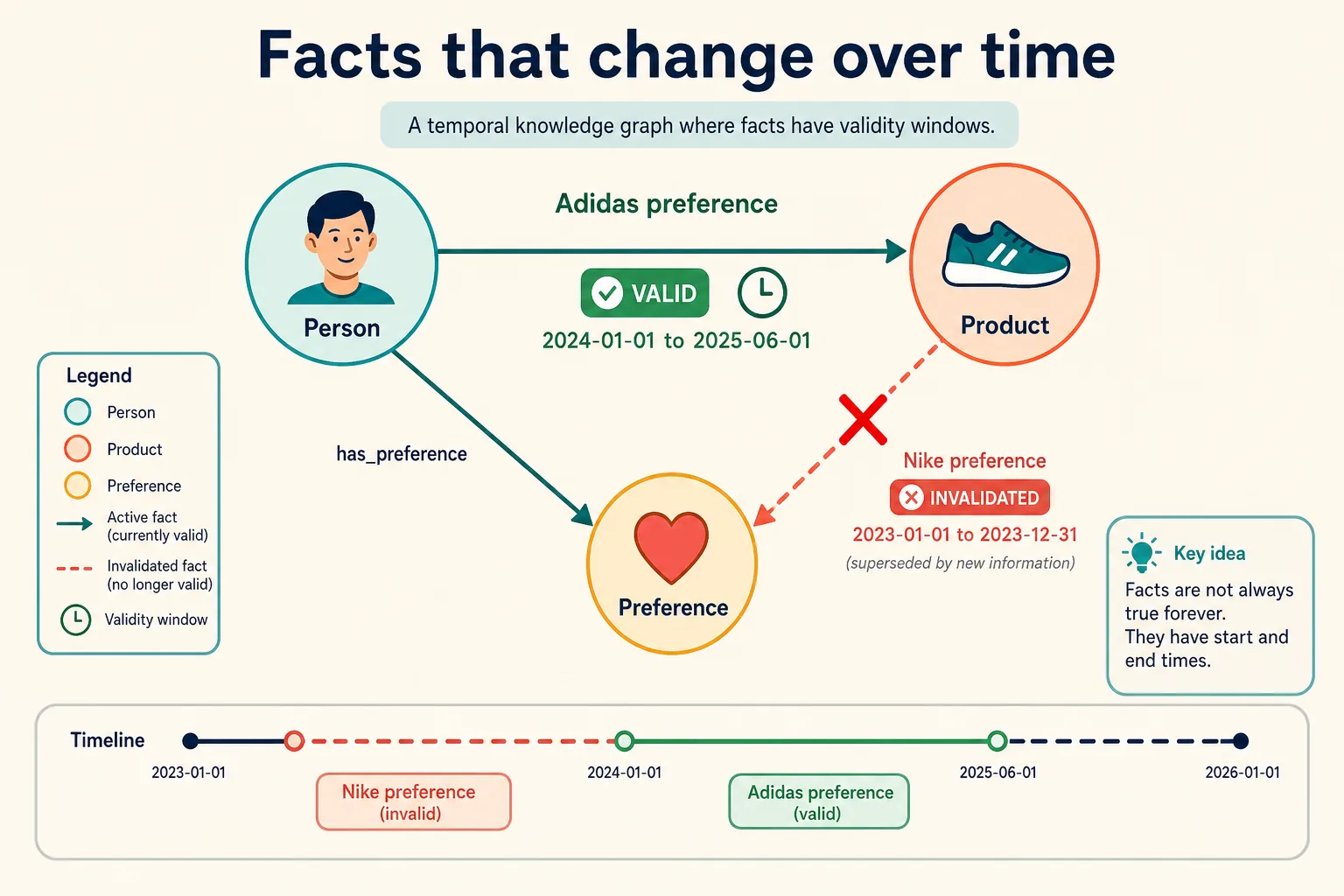
- Temporal modeling: facts carry validity; contradictions update the graph instead of silently stacking duplicates.
- Provenance from retrieved facts back to source episodes (as marketed).
- Scale narrative: many graphs, governed substrate, sub-200ms retrieval claims on their site.
- Framework-agnostic APIs (Python / TypeScript / Go examples on the homepage).
- Research surface that includes benchmarks such as LongMemEval — their published numbers; see their research page. We publish our own LongMemEval notes separately and do not claim a head-to-head here.
Where the agency job differs
A temporal knowledge graph is a powerful recall substrate. An agency still needs governance of work:
- Owner-facing conflict as a risk signal before the team builds the wrong thing (conflict detection design)
- Client-safe presentation of status without exposing the whole graph
- A portal and digest loop for humans who never call
thread.add_messages - MCP context for existing coding agents (Cursor, Claude Code) against this client’s constraints — not only for agents you build inside Zep’s API
You could assemble those pieces on Graphiti yourself. That is a platform engineering project. Accord Book is the packaged agency loop, not a general context lake.
Capability snapshot
| Capability | Zep / Graphiti | Accord Book |
|---|---|---|
| Primary ingest | Chat threads, business JSON/data, agent traffic | Work tools → project memory (Slack & GitHub shipped; more connectors low-friction) |
| Memory model | Temporal context / knowledge graph | Canonical project memories (+ optional graph projection) |
| Time / supersedes | First-class validity windows | Supersedes-aware lineage and current-state retrieval |
| Conflict handling | Fact invalidation when the world changes | Project decision conflicts surfaced to the owner |
| Human governance | Enterprise policy on the memory substrate | Owner arbitration; team/client portal |
| Agent interface | SDKs for agents you build | MCP for agents you already use |
| Hosting / data | Cloud, BYOK, BYOC (per their site) | Single-org self-host; customer LLM BYOK |
| ICP | Teams shipping production agents at scale | Boutique AI-native dev agencies (sweet spot ~20 engineers) |
When you should pick Zep anyway
Pick Zep when you are building or operating agents as the product, need temporal accuracy at volume, and want enterprise governance around context graphs. Pick Graphiti when you want the OSS temporal graph engine and will own Neo4j/FalkorDB (or similar) operations. Do not pick Accord Book to be your generic agent memory SaaS.
Where Accord Book fits
Accord Book uses hybrid retrieval for project state reconstruction (why production needs more than vector search, three lanes). Graph can help; it is not the whole product. The product is the agreement loop: ingest → conflict → human publish → MCP / digest.
Also in this series: landscape hub · vs Mem0 · vs Letta · vs Cognee · vs Notion · vs Obsidian · vs Linear
Product: Accord Book · Pilot