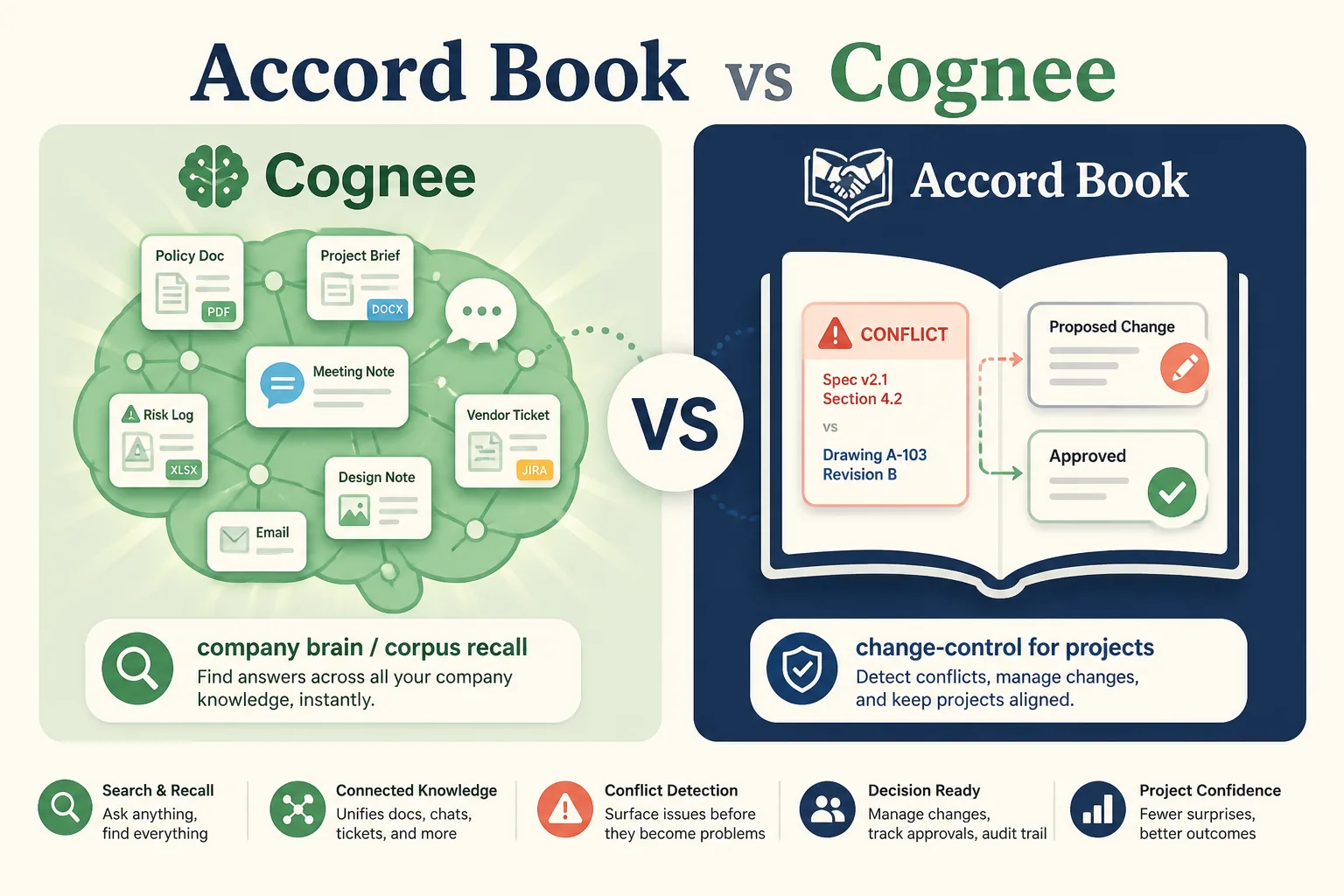
Cognee wants agents (and teams) to recall what the company already knows. Accord Book wants a small agency to keep a living agreement with the client — and stop agents from shipping against yesterday’s constraints. Overlap on work-tool ingest; different finish line.
What Cognee is
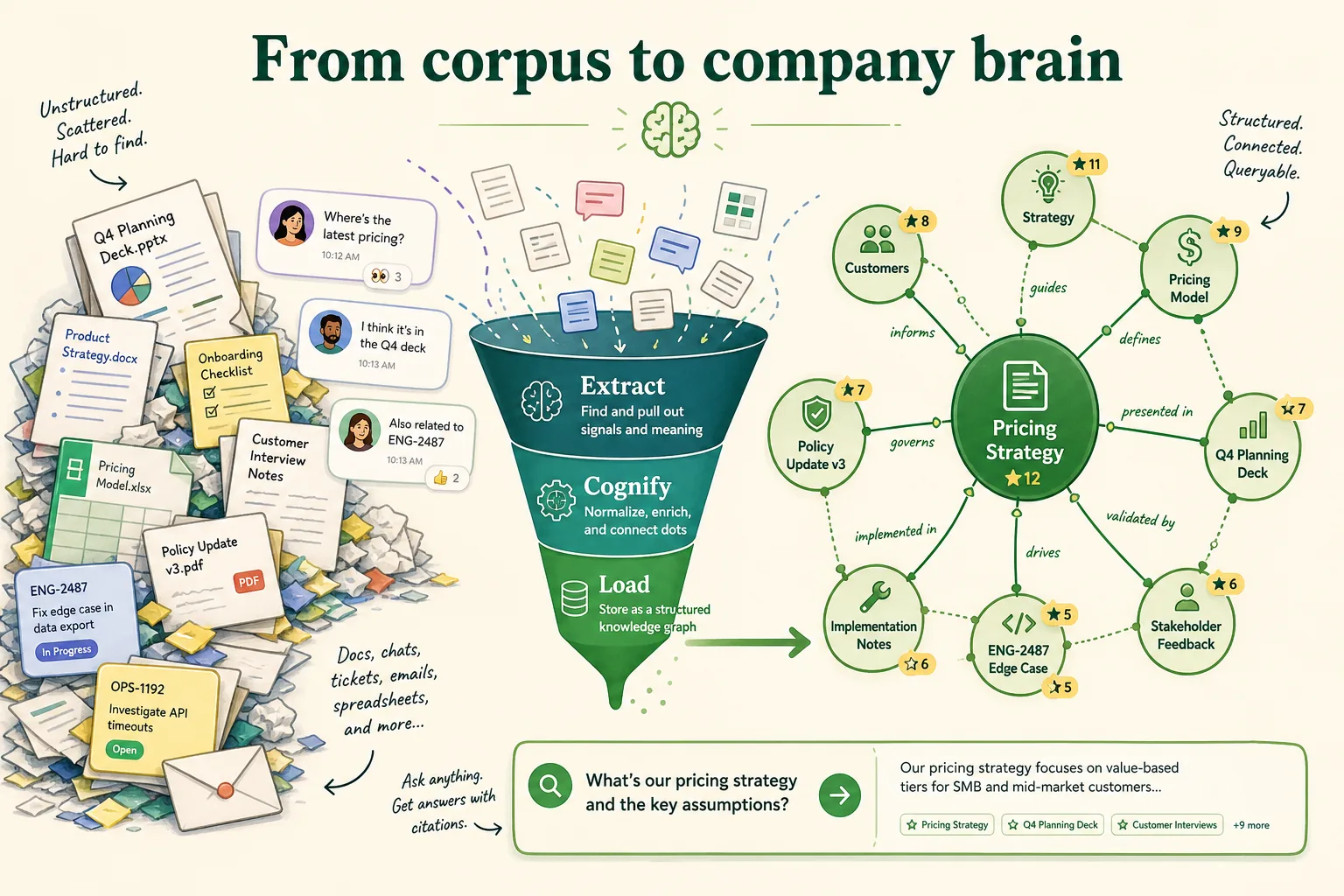
As of August 2026, Cognee markets an open-source memory platform for agents: connect sources such as Slack, GitHub, and Linear; build structured memory with entities, relationships, and ontologies; query via SDK or MCP. Their site emphasizes a “company brain,” local/quickstart paths (pip install cognee), connectors for data teams, and BYOC for production. OSS: github.com/topoteretes/cognee.
Their best case: turn a heterogeneous corpus (docs, chats, tickets, code) into recallable, cited knowledge for coding agents and internal search — closer to graph-RAG / knowledge-engineering than to a ticket tracker.
Where Cognee is strong
- Explicit connectors for the tools agencies already use (Slack, GitHub, Linear named on their homepage).
- Structured memory via entities, relationships, and auto-generated ontologies — not only flat chunks.
- MCP and first-party hooks for Claude Code, Cursor, LangGraph, and similar.
- Open-source entry with a path to managed / BYOC when you need ops help.
- Strong fit when “memory” really means “make this corpus recallable.”
Where the agency job differs
A company brain that answers “what do we know?” is valuable. Overlapping connectors (Slack, GitHub, tickets) are not the differentiator — those walls are thin either way. An agency still needs change-control:
- Conflict as a risk signal when a new client ask fights an older decision (how we design that)
- Human publish-to-truth so the portal is not just another search box (AI proposes, humans publish)
- Client-tier digests that are safe by construction, not a filtered dump of the graph
- Single-org self-host with customer LLM BYOK (bring your own model-provider key) as the default commercial shape for this ICP
Cognee can be the retrieval brain behind agents. Accord Book is the governed project record those agents — and the client — orbit.
Capability snapshot
| Capability | Cognee | Accord Book |
|---|---|---|
| Primary ingest | Docs, chats, tickets, code, agent runs (connectors) | Work tools → project memory (Slack & GitHub shipped; more connectors low-friction) |
| Memory model | Graph + vector company brain / ontology | Provenance-tracked project memories |
| Time / supersedes | Evolving graph from use / updates | Supersedes-aware lineage for decisions |
| Conflict handling | Retrieval quality and structure | Explicit conflict pipeline → owner |
| Human governance | Permissions / company brain access | Owner arbitration; team/client portal |
| Agent interface | SDK + MCP | MCP for coding agents |
| Hosting / data | OSS local, cloud, BYOC (per their site) | Single-org self-host; customer LLM BYOK |
| ICP | Teams building agentic company memory | Boutique AI-native dev agencies (sweet spot ~20 engineers) |
When you should pick Cognee anyway
Pick Cognee when you are assembling a company-wide recall layer for many agents, need ontology-shaped memory over a large corpus, or want an OSS SDK first and will own the integration work. If your only gap is “Claude Code forgets our internal wiki,” Cognee is in-category. If the gap is “client said X, we decided Y, agent did Z,” you need change-control, not only recall.
Where Accord Book fits
Accord Book’s loop is ingest → provenance → conflict → digest/MCP for one org’s projects. Retrieval matters (hybrid retrieval); the product promise is coherent delivery under AI agents, not a general knowledge platform.
Also in this series: landscape hub · vs Mem0 · vs Zep · vs Letta · vs Notion · vs Obsidian · vs Linear
Product: Accord Book · Pilot