Project memory and change control for AI-native delivery teams
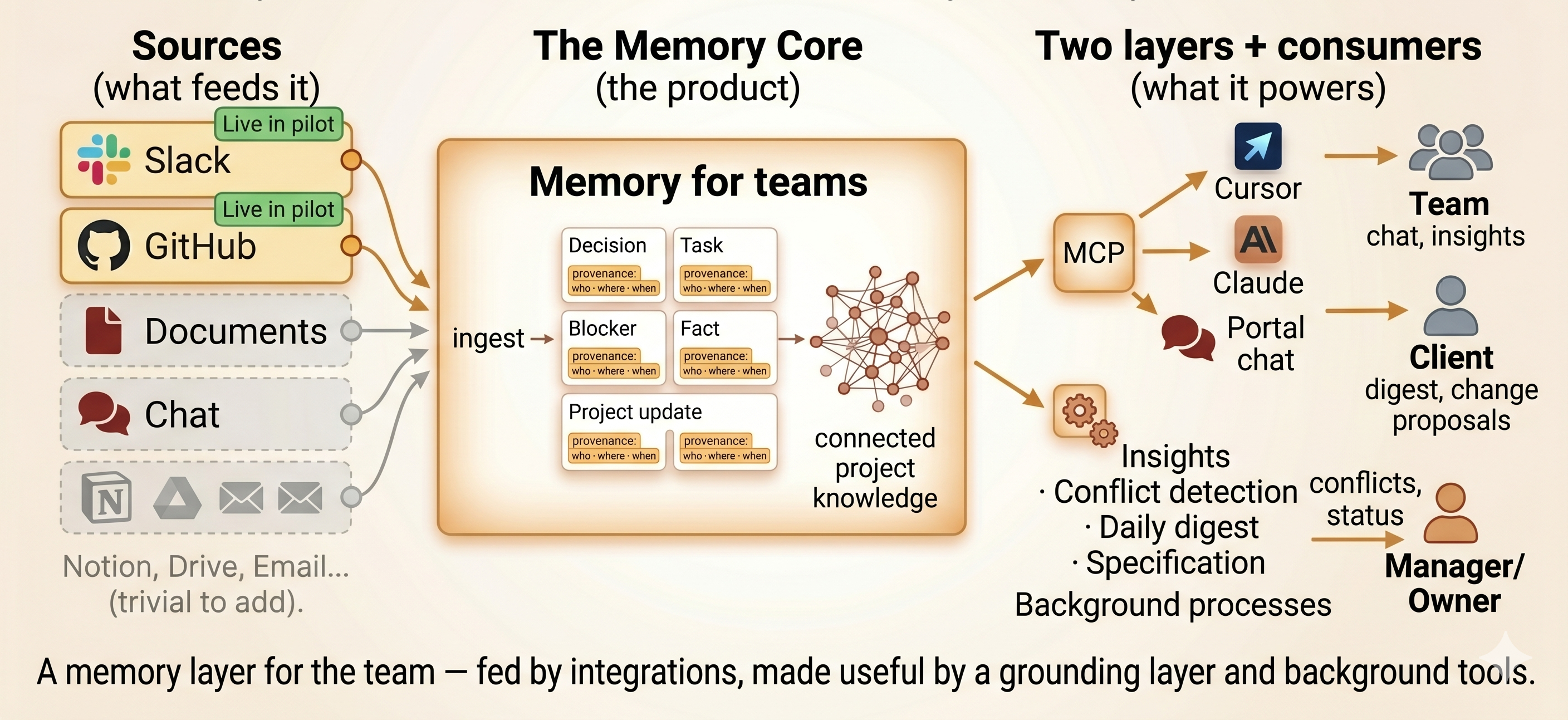
Accord Book captures decisions and constraints from normal work — Slack, GitHub, uploads, voice, docs — detects conflicts before drift turns into rework, drafts client-safe updates, and proposes Git-backed context under human approval.
Built for 3–15 person agencies where the owner is simultaneously technical lead, PM, and client translator.
Three capabilities that are shipped, measured, and ready for pilot teams to put to work.
100% precision, 92.86% recall across 86 scenarios on the May 2026 benchmark run — zero observed false positives. Surfaces review-worthy contradictions with provenance, keeps owners in control.
Owner arbitration, ingestion backlog visibility, per-install Slack outbound, agent preflight via MCP, and Git-backed spec generation are all live in the current release.
Vector retrieval, lexical recovery, and supersedes-aware reranking reconstruct current project state — not just semantically similar text. Validated at 990ms p95 and 90% judged accuracy.
Most project drift starts the same way: the latest request lives in one place, the decision it conflicts with lives somewhere else, and the team only connects them after rework begins.
Pull project inputs from Slack, GitHub, uploaded documents, URLs, and docs into a project-scoped memory with timestamps and provenance. No manual tagging required.
Retrieval designed for changing project truth: vector search, lexical recovery, and supersedes-aware reranking find what is current — not just what sounds similar.
Turn structured claims into conflict candidates and durable findings, then present the useful subset for owner review with supporting provenance.
Generate digests and Git-backed .q_context documentation updates as proposals. Humans review and publish what becomes authoritative — AI proposes, the team decides.
Accord Book replaces scattered, reactive coordination with a single governed project memory layer.
| Without Accord Book | With Accord Book |
|---|---|
| Project truth scattered across tools | Project memory assembled into one scoped system |
| Stale decisions resurface as if current | Superseded context down-ranked and traceable |
| Client updates require manual synthesis | Digests draft from project memory — owners approve before sending |
| Spec drift accumulates silently in docs repos | .q_context updates proposed by PR — humans merge what becomes authoritative |
| Conflict review starts after rework begins | Review-worthy contradictions surface earlier, with provenance attached |
Accord Book is built for working loops where agents, humans, and clients all need to operate from the same project record.
.q_context/ via PR — merge to publishBefore an agent acts, it queries Accord Book for constraints, failed approaches, and relevant project history — via MCP, so any coding or voice agent can use it.
When new requests conflict with prior decisions or constraints, owners get a provenance-backed review surface with resolve, defer, and reopen actions. Decisions become part of the project record.
Accord Book drafts plain-language project summaries from actual memory and approved evidence — not from a generic chat recap. Owners review before anything reaches the client.
Founding pilot cohort — June 2026
We are working directly with a small cohort of AI-native dev agencies to validate Accord Book in real delivery environments. Pilot teams get the full product, hands-on setup with the founders, and founding-cohort pricing that locks in before public launch.
We configure Accord Book for your project structure, input sources, and delivery workflow together. You are not reading docs alone.
Pilot teams work directly with the founders. Your real-project feedback shapes the roadmap before the public release.
Pilot pricing locks in before the public launch rate. Teams keep their rate as Accord Book grows and the product expands.
Built for 3–15 person agencies doing AI-assisted delivery. BYOK for LLM and embeddings — no token margin passed to you.
Or email desk@vector-intelligence.io directly.