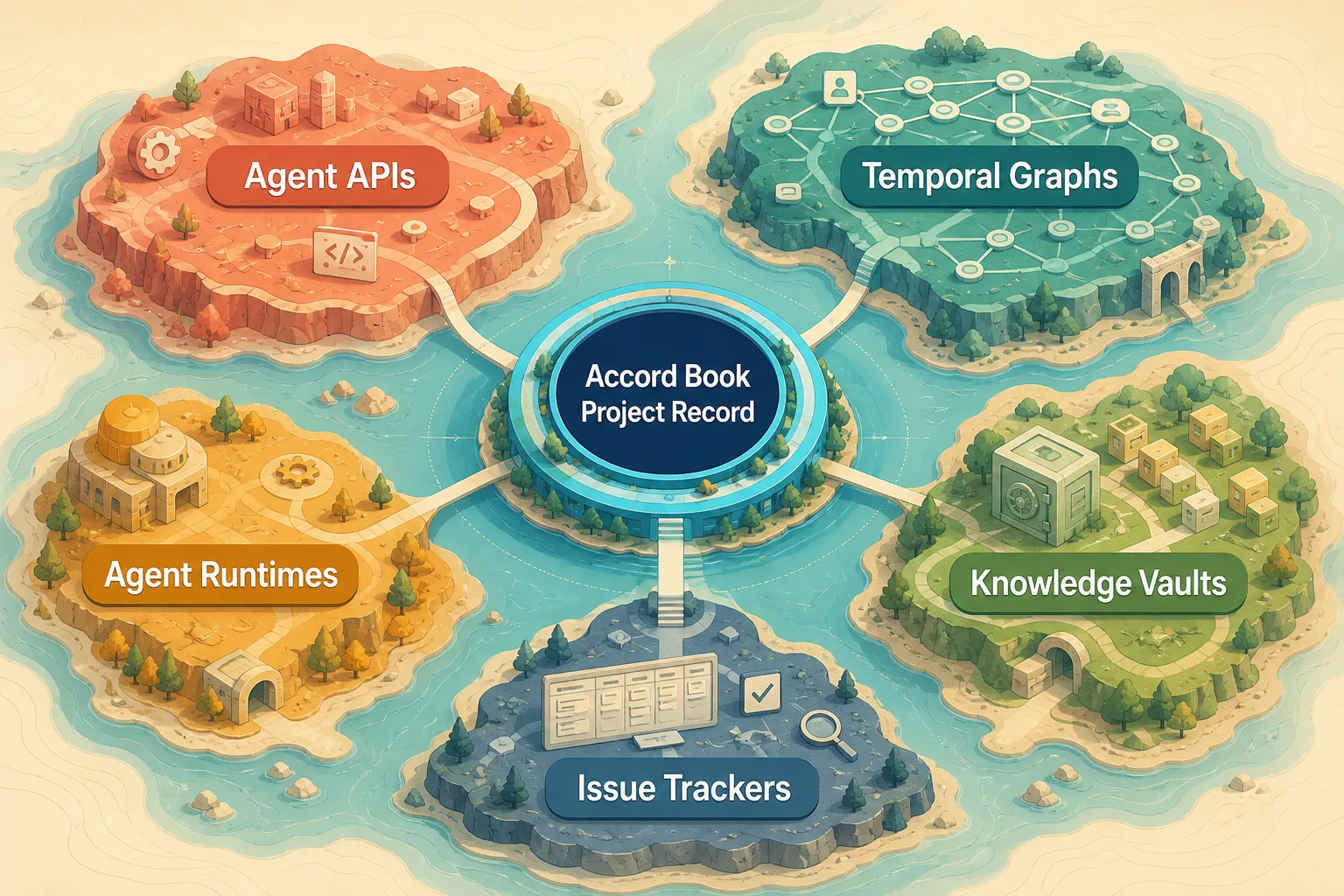
“AI memory” is a crowded search result. As of August 2026, that phrase covers several different jobs. Mixing them up is how you buy an SDK when you needed a project record — or keep a wiki and wonder why coding agents still ask the same questions every sprint.
This post is the map. Each linked comparison is fair about strengths, honest about limits, and clear about where Accord Book fits for a boutique dev agency (sweet spot often up to ~20 engineers).
Jobs people call “memory”
| Job | What you are buying | Typical tools |
|---|---|---|
| Per-user / agent personalization | Facts about a user or chat that persist across sessions | Mem0, parts of Zep |
| Temporal / graph recall for agents | Entities and facts that change over time, queryable by agents | Zep / Graphiti, Cognee |
| Stateful agent runtime | An agent that manages its own context like an OS | Letta (MemGPT lineage) |
| Human-curated knowledge | Notes and pages people write and organize | Notion, Obsidian |
| Delivery tracking | Work items, cycles, ownership | Linear |
| Team memory for client work (search category) | Approved knowledge folders + agent connections | Estratos, MemoryLake |
| Unified project conversation brain | Calls, chats, files → cited RAG + MCP | TalkBase |
Accord Book is none of those as a primary job. It is shared project memory and change-control: ingest the tools where work already happens (Slack and GitHub ship today; more connectors are low-friction), keep provenance-tracked decisions, surface conflicts, expose context to agents via MCP, and give the team and client a portal. Deeper framing: why AI teams need a memory layer.
Data is the product; folders are presentation
Agencies that live in Notion or Obsidian often treat the page tree, tags, or graph as the system of record. That hierarchy is useful — it is also a presentation layer. The durable asset is the collected data: what was decided, under which constraint, from which thread or commit, and what superseded it.
When data is the center, you can rebuild views: a client digest, an MCP answer for Cursor or Claude Code, an admin inspection screen, even a vault-style export later. When organization is the center, every new audience needs another pile of pages. That split is the spine of the Notion and Obsidian posts.
How to choose (short)
- Building a chatbot that should remember preferences → start with something like Mem0.
- Building agents that must know what was true when over a changing world → look at Zep / Graphiti or Cognee.
- Shipping a long-running agent whose identity is its memory → look at Letta.
- Writing and owning Markdown knowledge as a craft → Obsidian (or Notion for hosted collaboration).
- Running product delivery → Linear.
- Keeping a living agreement across client, team, and coding agents — with conflict as a risk signal and humans publishing truth → Accord Book.
- Professional-services team memory (folders, approvals, multi-client knowledge) → Estratos or MemoryLake depending on ICP.
- Searchable project brain from calls and chats with citations → TalkBase.
Comparisons in this series
Direct search competitors (agency buyer phrases)
- Accord Book vs Estratos — team memory for AI-assisted client work
- Accord Book vs MemoryLake — client context memory for agencies
- Accord Book vs TalkBase — AI project memory with citations vs change-control
AI memory stack & delivery tools
- Accord Book vs Mem0 — per-user agent memory vs agency project record
- Accord Book vs Zep — temporal context graphs vs governed project spec
- Accord Book vs Letta — agent runtime vs a layer that governs agents
- Accord Book vs Cognee — company-brain / corpus pipeline vs change-control
- Accord Book vs Notion — page tree as presentation vs data-first record
- Accord Book vs Obsidian — vault structure as presentation vs collected data
- Accord Book vs Linear — tickets vs living agreement
Claims in those posts are dated to August 2026 and grounded in each product’s public site and docs — not third-party roundups. We do not invent competitor pricing or run fake head-to-head benchmarks.
If the problem is status-call tax, onboarding tax, and agents that forget client decisions, start at the product page or the pilot overview.