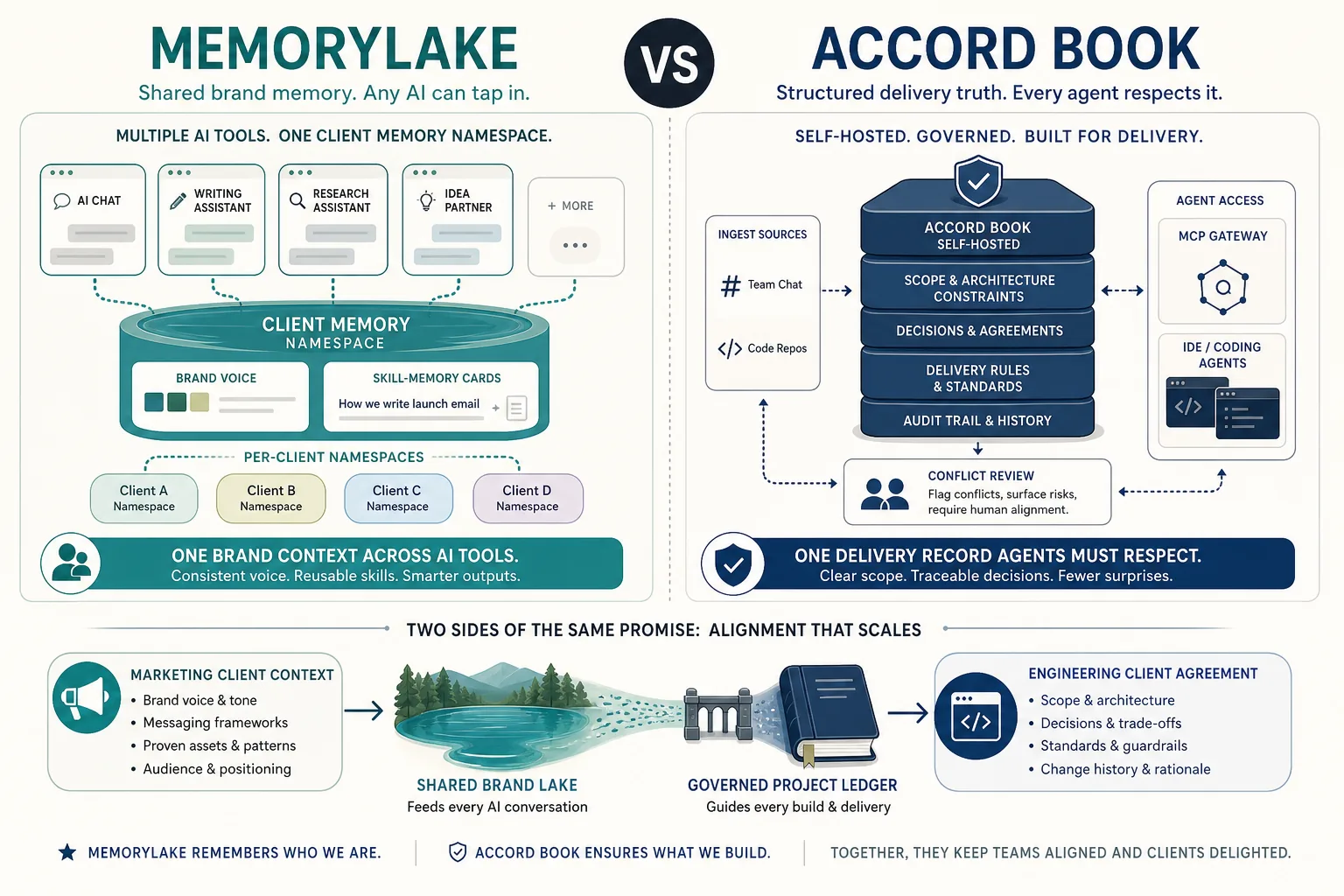
“Client context memory for agencies” is a search phrase MemoryLake owns in marketing copy on their homepage and client context use case. Accord Book targets the same buyer vocabulary with client context memory for agencies — but the products solve overlapping words with different centers of gravity.
What MemoryLake is
MemoryLake positions as an AI memory layer that works across tools: ChatGPT, Claude, and others retrieve the same stored context instead of each session starting cold. Overview: memorylake.ai.
For agencies specifically, their client context use case emphasizes:
- One memory namespace per client — brand guidelines, approved language, campaigns, key contacts
- Skill memory — reusable patterns like “how we write a launch email for Client X”
- Cross-tool consistency — same brand voice whether copy runs in ChatGPT or strategy in Claude
- Provenance — memory linked back to signed-off briefs and audits
- Connect → structure → reuse — import briefs and guides; organize into background, facts, events, skill memory
They also sell adjacent use cases (brand voice, PM project memory, sales call memory, creative brief memory). Pricing messaging includes a “free forever” tier on the marketing site (August 2026).
Where MemoryLake is strong
- Account-manager pain is explicit — switching clients without re-pasting the brand guide every time.
- Marketing-agency ICP — 10+ clients, brand consistency, retention risk from off-brand AI output.
- Tool-agnostic memory API — valuable when the agency already runs a stack of chat UIs, not one IDE agent.
- Namespace isolation story — per-client boundaries, encryption, export/delete on offboarding (per their FAQ).
- Fast time-to-value — no self-host deployment; connect and import.
Brand namespaces vs engineering constraints
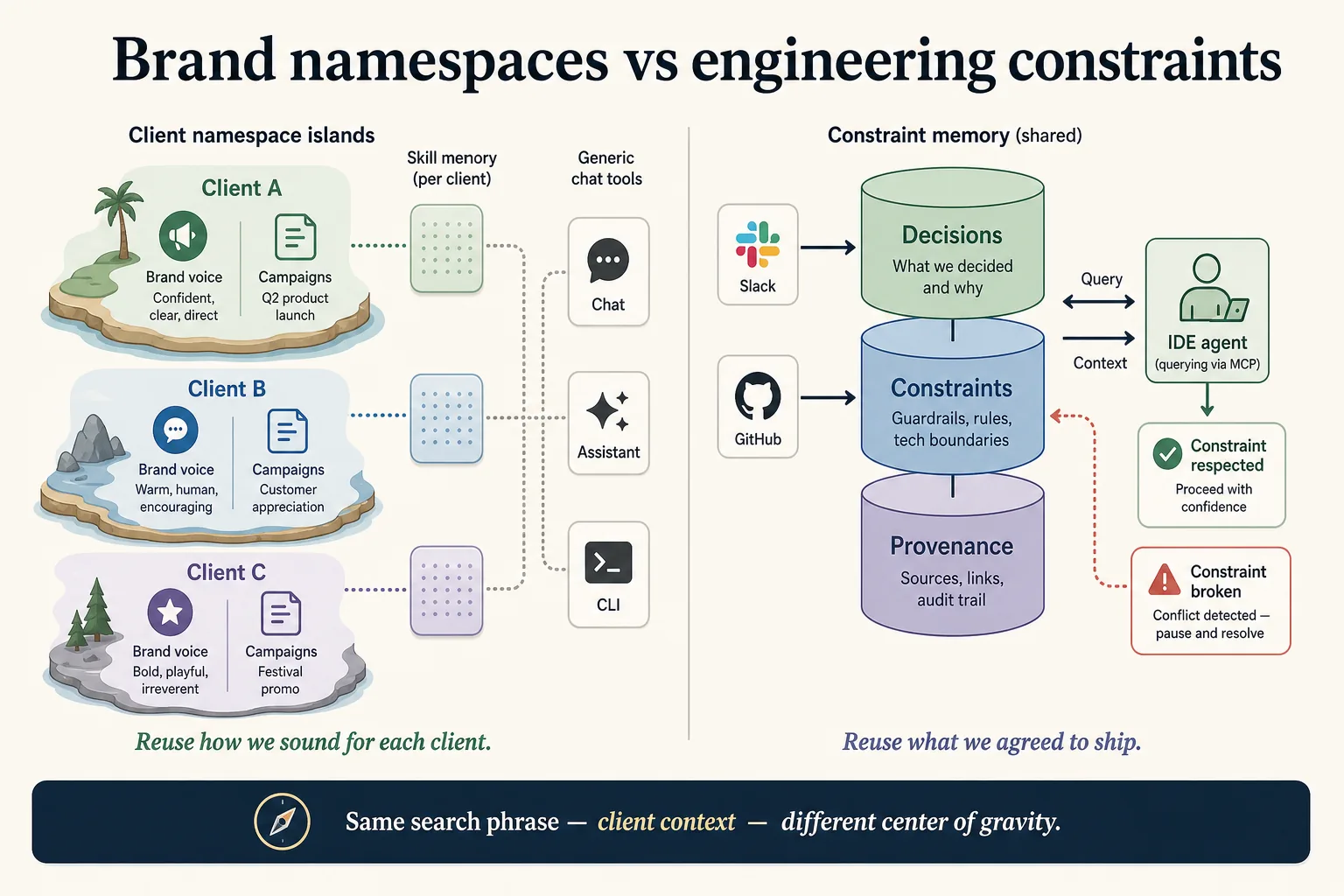
MemoryLake’s agency story is brand and deliverable context — voice, campaigns, “how we write X for Client Y.” That is real money for creative and marketing shops.
A dev agency shipping software hits an adjacent but different failure mode:
| Pain | MemoryLake framing | Dev agency reality |
|---|---|---|
| Context loss | Re-brief AI on brand voice | Re-brief on scope, architecture, and constraints |
| Source of truth | Imported briefs and approved assets | Slack threads, PRs, descoped tickets |
| Agent surface | Any AI tool via memory layer | Cursor / Claude Code via MCP on a repo |
| Drift | Off-brand copy | Conflicting specs — client asked for X, code still assumes Y |
| Governance | Skill memory blocks off-brand output | Owner arbitration on contradictions with provenance |
Accord Book ingests delivery evidence (Slack, GitHub, uploads, voice, docs), runs conflict detection as a risk signal, and exposes MCP so coding agents preflight before acting. Client-safe digests are drafted from project memory — not primarily brand skill templates.
Capability snapshot
| Capability | MemoryLake (agency use case) | Accord Book |
|---|---|---|
| Primary memory content | Brand, campaigns, stakeholder profiles, deliverable skills | Decisions, constraints, blockers with provenance |
| Ingest model | Import / connect client assets | First-party connectors from work tools |
| Per-client isolation | Memory namespaces | Project-scoped RBAC in single-org deploy |
| Cross-tool AI | Core value prop | MCP for coding agents; portal for humans |
| Conflict / drift | Not the headline | Two-stage detection → owner review |
| Engineering artifacts | Not emphasized | Git-backed .q_context proposals via PR |
| Hosting | Hosted SaaS (per site) | Self-hosted; BYOK |
| ICP (agency) | Marketing / creative / digital (10+ clients) | Boutique AI-native dev agencies (sweet spot ~20 engineers) |
When you should pick MemoryLake
Pick MemoryLake when:
- Your agency’s AI work is copy, strategy, and client-facing content across many brands.
- The cost is AM time re-loading context and off-brand drafts, not merge conflicts or spec drift.
- You want a hosted memory product that follows the team across chat tools — not a Docker stack on your VPS.
Evaluate on memorylake.ai and the agency client-context page.
When Accord Book fits better
Pick Accord Book when:
- Client context includes what engineering agreed to ship — not only how the deck sounds.
- You need Slack + GitHub in the same project record agents can query.
- Self-hosting is non-negotiable for client repositories and conversation data.
- Your agents live in the IDE, not only in browser chat.
Related: client context memory for agencies · why AI teams need a memory layer · what Accord Book actually costs.
If you are a full-service shop (brand + build), the honest answer may be two layers someday — brand skill memory for client comms and a delivery record for engineering. Most small agencies should still pick which pain is P0.
Also in this series: landscape hub · vs Estratos · vs TalkBase · vs Notion · vs Mem0
Product: Accord Book · Pilot · Pricing