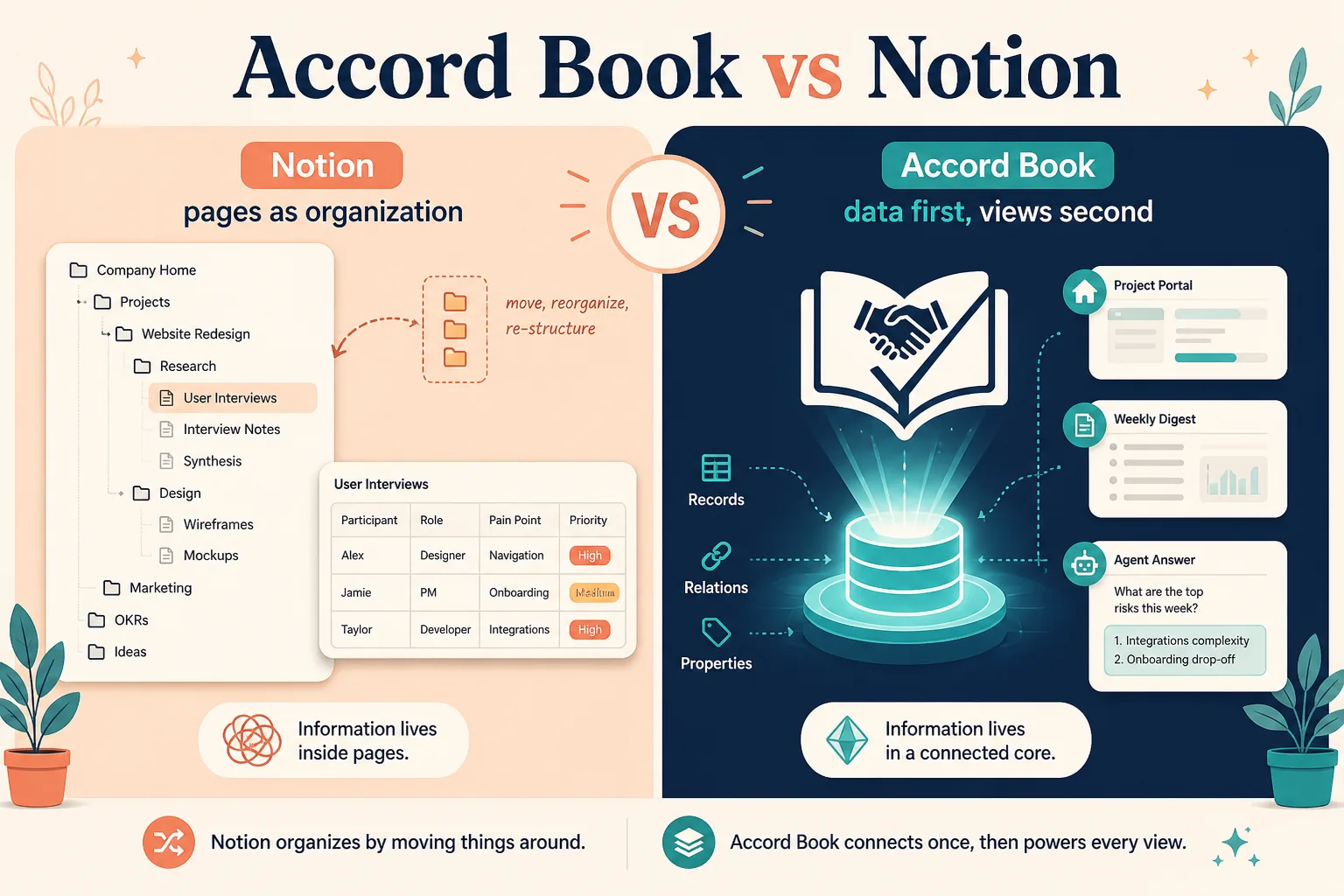
Notion is where many agencies already “remember” things: project pages, meeting notes, client wikis. Accord Book treats that page tree as what it is — a presentation layer — and puts collected data at the center instead.
Same class as Obsidian (human-curated knowledge); different shape (hosted collaboration vs local-first vault).
What Notion is
Notion is a hosted workspace of pages, databases, and nested docs. Teams write, link, and rearrange until the hierarchy matches how they think. As of August 2026 it remains a default home for SOPs, client briefs, and meeting notes. AI features can summarize or draft inside the workspace; the system of record is still pages people maintain.
Their best case: a readable, shared wiki that non-engineers will actually open.
Where Notion is strong
- Low friction for mixed roles — clients, PMs, and engineers can all edit.
- Flexible databases and templates for almost any internal process.
- Excellent as a writing and collaboration surface.
- Already paid for in many agencies; no new vendor fight for “where do docs live.”
- Good enough search for human browsing when the workspace is small and tended.
Where the agency job differs
The directory is not the asset
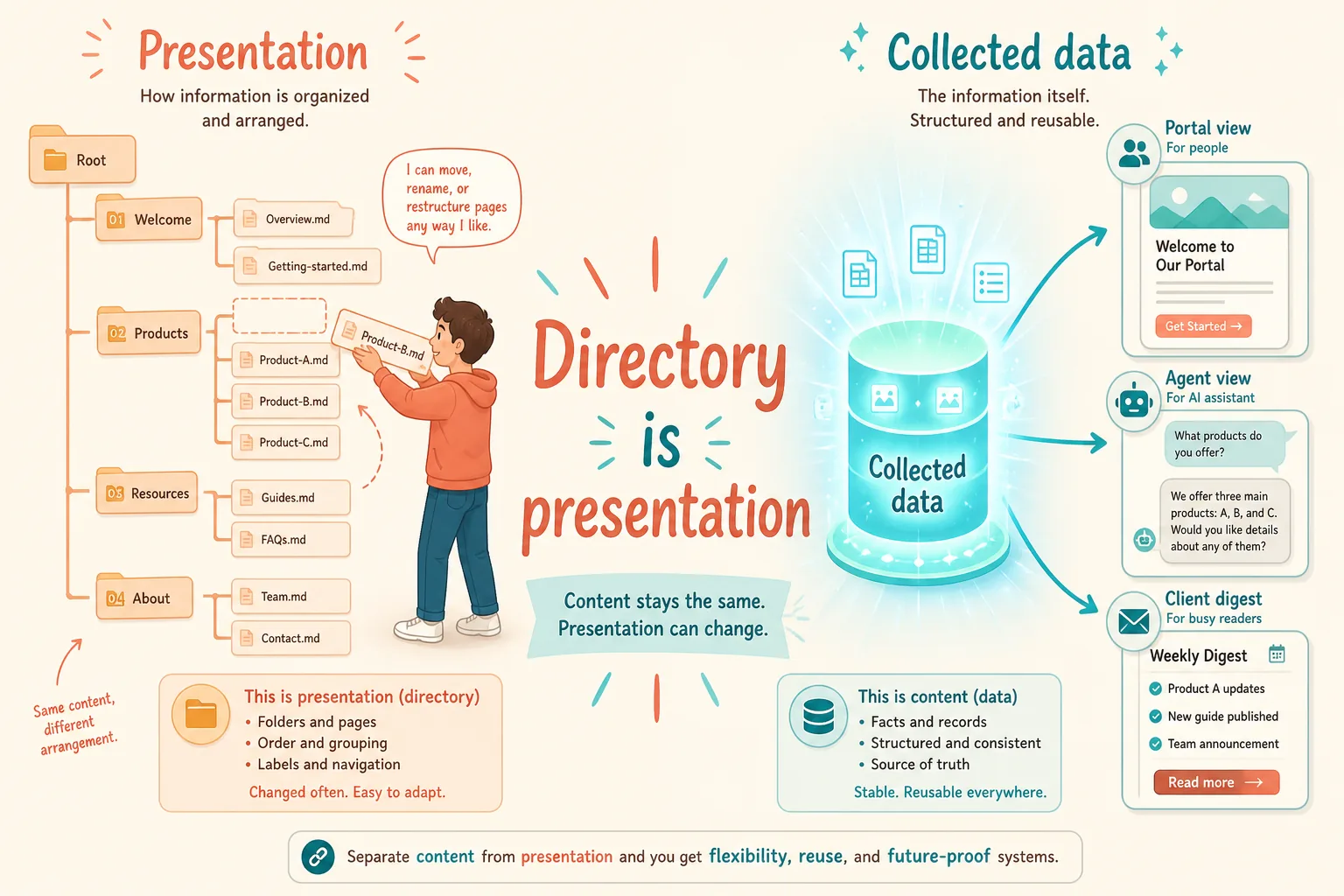
Folders, nested pages, and database views help humans navigate. They are not the durable value. The durable value is the data: the decision, the constraint, who said it, which thread or commit it came from, and what replaced it.
When organization is the product, every new audience needs a new arrangement — a client-facing page, an internal page, a “AI context” page that goes stale by Thursday. When data is the center (Accord Book), presentation can be redone: portal digest, MCP answer for Cursor, admin inspection, later an export if you want a wiki view.
Automation and agents
Notion does not turn the places decisions actually happen into a provenance-tracked memory store on its own. Someone still copies the call into a page. That is the real friction — not which chat or repo brand you use.
Accord Book’s job is that accumulation layer. Slack and GitHub ship today; wiring another source (including a Notion export or database sync, or a competitor’s API where it helps) is the same connector pattern, not a product rewrite. Coding agents then get a governed project record with first-class conflict detection and owner arbitration — not a homemade bridge that still leaves publish-to-truth unsolved.
Capability snapshot
| Capability | Notion | Accord Book |
|---|---|---|
| Primary ingest | Humans write pages | Work tools → project memory (Slack & GitHub shipped; more connectors low-friction — including tools like Notion) |
| Memory model | Documents and databases | Provenance-tracked project memories |
| Time / supersedes | Page history / manual updates | Lineage and current-state retrieval |
| Conflict handling | Comments and process | Explicit conflict pipeline → owner |
| Human governance | Workspace permissions | Owner arbitration; team/client portal |
| Agent interface | Ad hoc / AI in-doc / custom | MCP for coding agents |
| Hosting / data | Notion cloud | Single-org self-host; customer LLM BYOK |
| ICP | General knowledge work | Boutique AI-native dev agencies (sweet spot ~20 engineers) |
When you should pick Notion anyway
Pick Notion when the job is human collaboration and readable docs — proposals, HR, marketing, a client handbook. Keep using it. Accord Book is not trying to be your company wiki. If the team will not write ADRs unless they live next to the sprint notes, Notion still wins for that writing habit.
Where Accord Book fits
Accord Book accumulates the project record from work, then shows it however each audience needs (memory layer framing, humans publish). Notion can remain the place you draft the proposal; Accord Book is the place the agreement stays true after the agents start coding.
Also in this series: landscape hub · vs Mem0 · vs Zep · vs Letta · vs Cognee · vs Obsidian · vs Linear
Product: Accord Book · Pilot