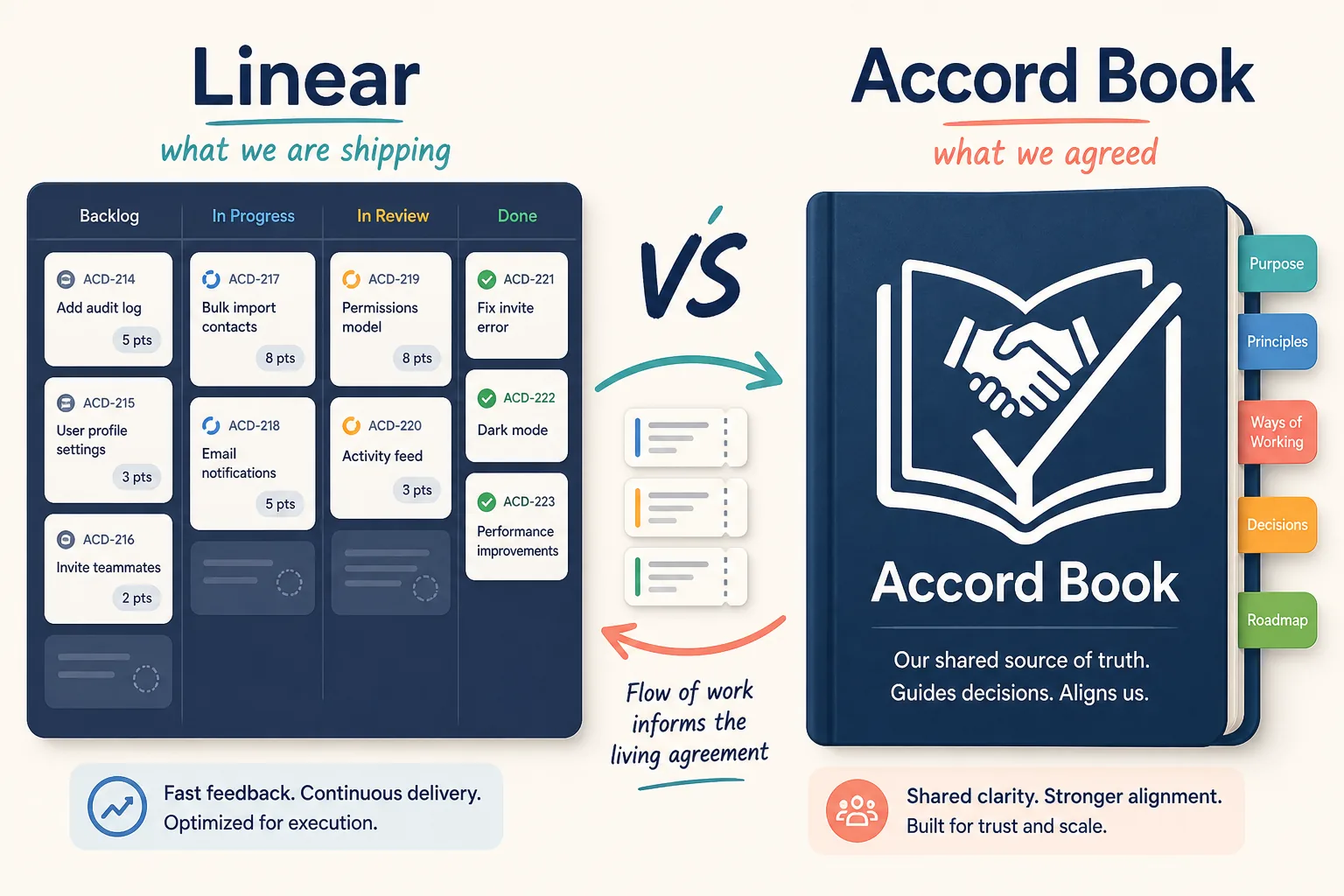
Linear is how many product teams run delivery: issues, cycles, initiatives, and increasingly agents in the workflow. Accord Book is how an agency keeps the living agreement — decisions and constraints — so those issues do not quietly contradict what the client already accepted.
If you only use one sentence: Linear answers “what are we shipping?” Accord Book answers “what did we decide, and does this fight it?”
What Linear is
As of August 2026, Linear markets itself as a product development system for teams and agents: intake from conversations, planning and roadmaps, AI/agent workflows (including drafting work and coding sessions), and shipping with reviews and cycles. It is purpose-built for modern product orgs that want speed and clear ownership. Homepage: linear.app.
Their best case: a team that lives in issues, moves fast, and wants agents to help execute work that is already framed as tickets.
Where Linear is strong
- Best-in-class issue tracking UX for product engineering teams.
- Strong planning surfaces (projects, initiatives, cycles).
- Agent-aware workflows — agents as teammates on issues, not only chat toys.
- Integrations and intake that turn conversations into actionable work.
- Cultural fit for agencies that already think in tickets and PRs.
Where the agency job differs
Linear stores work items. It does not store a provenance-tracked memory of why we refused the scope change or which auth constraint is frozen. You can keep Linear for delivery and still feed issues into Accord Book later — complementary, not mutually exclusive. Issue descriptions can hold prose, but:
- They go stale the same way wikis do
- They are not a hybrid-retrieval project state (why vector search alone fails)
- They do not run two-stage conflict detection before an agent implements the conflicting ask
- Clients rarely get a safe, always-on digest of agreement state from the issue tracker alone
Agents that “work in Linear” still need project memory elsewhere — or they re-learn constraints every session.
Capability snapshot
| Capability | Linear | Accord Book |
|---|---|---|
| Primary ingest | Issues, intake, docs in Linear | Work tools → project memory (Slack & GitHub shipped; Linear and other trackers are natural next connectors) |
| Memory model | Work items + descriptions | Provenance-tracked project memories |
| Time / supersedes | Issue history / status | Decision lineage and current-state retrieval |
| Conflict handling | Process / comments / re-prioritization | Explicit conflict pipeline → owner |
| Human governance | Team workflow in Linear | Owner arbitration; team/client portal |
| Agent interface | Linear agents / MCP (per their product) | MCP for coding agents against project memory |
| Hosting / data | Linear cloud | Single-org self-host; customer LLM BYOK |
| ICP | Product teams shipping software | Boutique AI-native dev agencies (sweet spot ~20 engineers) |
When you should pick Linear anyway
Almost always keep Linear (or Jira, or GitHub Issues) if you run delivery that way. Accord Book is not an issue tracker — and it does not need to replace Linear to work with it. Pick Linear when the problem is triage, velocity, and ownership. Pick Accord Book when the problem is institutional memory and change-control under coding agents. Ingest from Linear (or keep tickets there and memory elsewhere) is a connector decision, not a hard border.
Where Accord Book fits
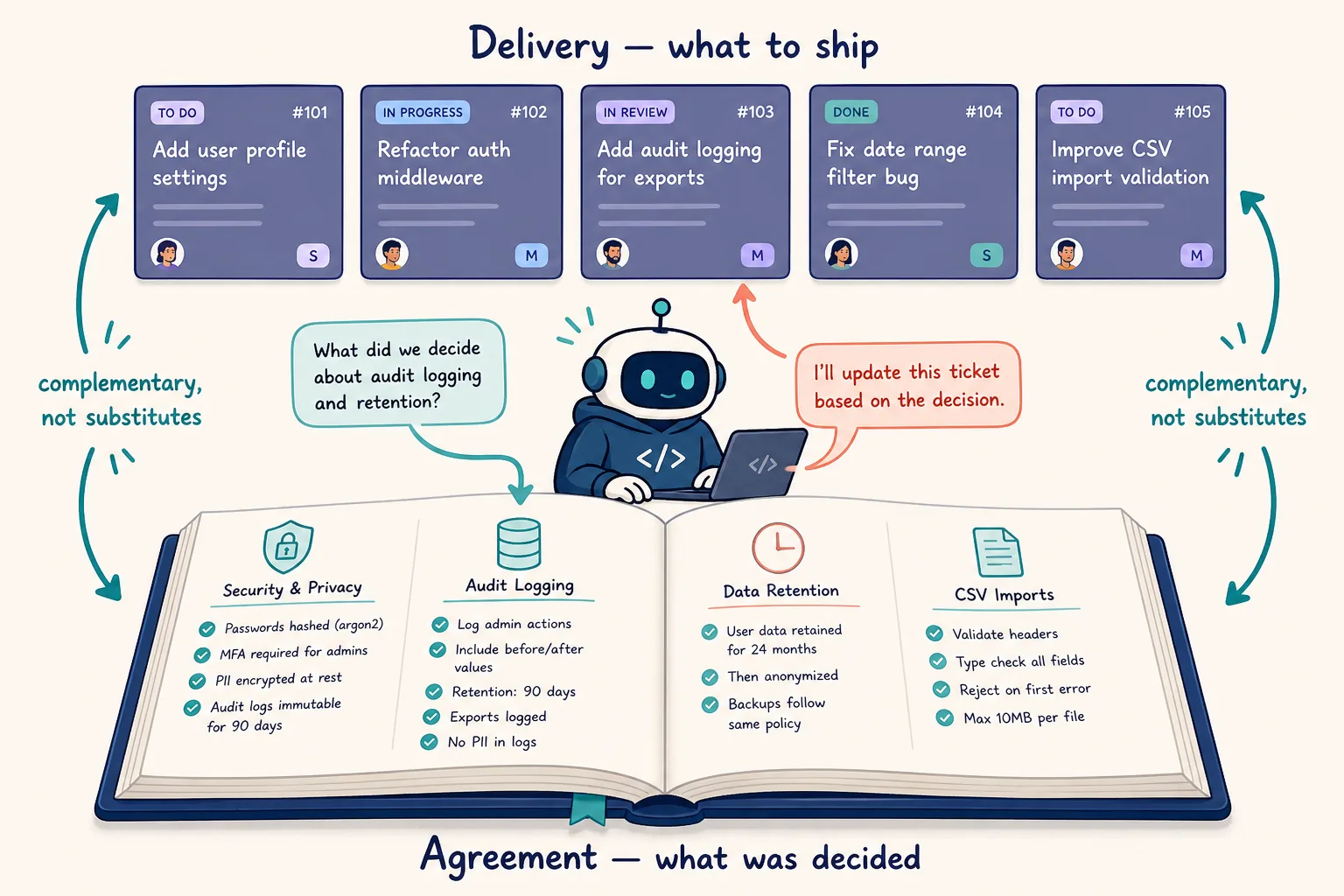
Complementary stack: Linear for doing, Accord Book for agreeing. Agents query MCP for constraints before they touch the wrong module; owners see conflicts; clients get digests without another status call (cost framing). Landscape: AI memory map.
Also in this series: landscape hub · vs Mem0 · vs Zep · vs Letta · vs Cognee · vs Notion · vs Obsidian
Product: Accord Book · Pilot