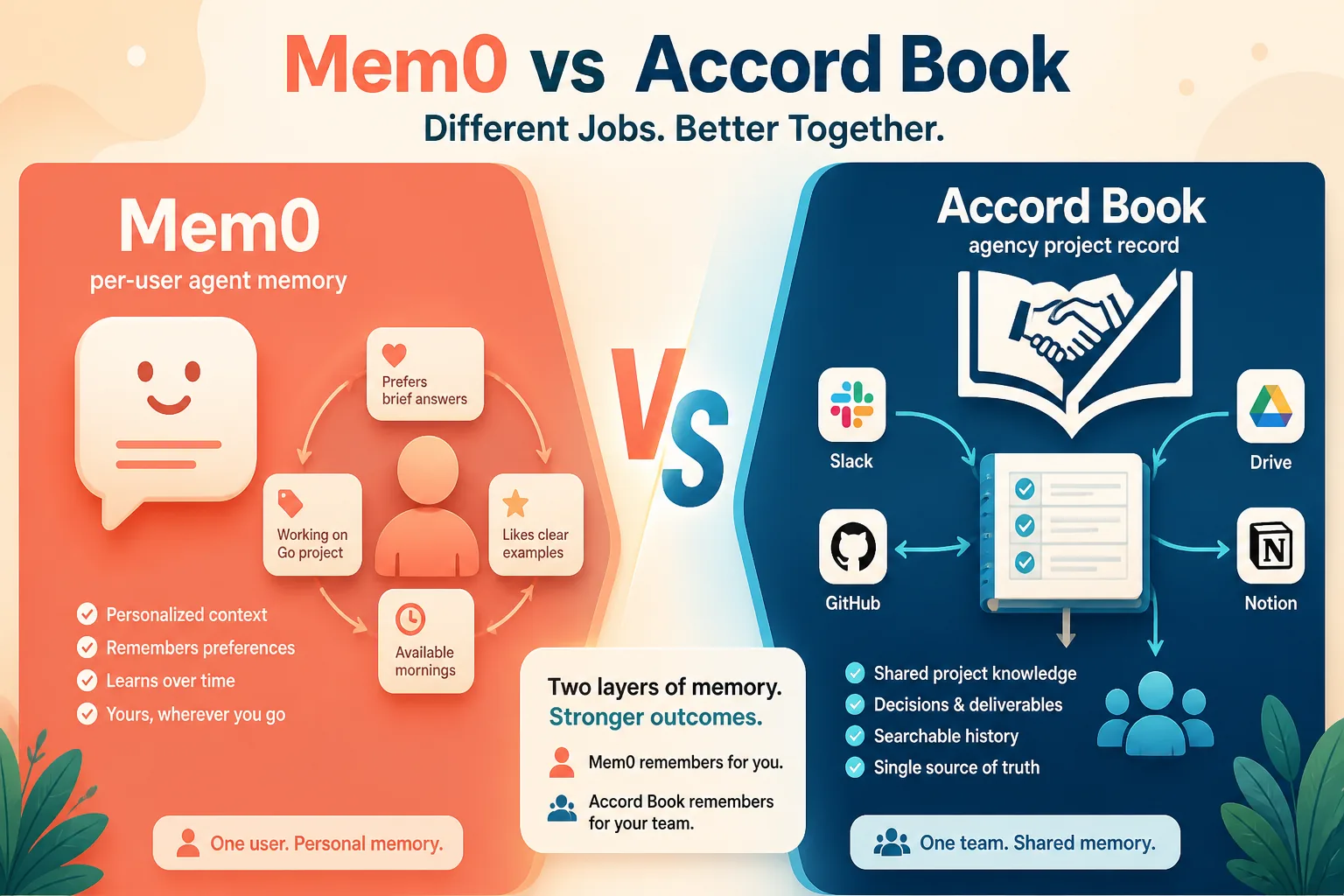
Mem0 remembers what a user or agent said across sessions. Accord Book remembers what a project decided — with provenance, conflict signals, and a portal for people who are not the agent.
That is the whole comparison. The rest is detail.
What Mem0 is
As of August 2026, Mem0 markets itself as drop-in memory infrastructure for AI agents and apps: add conversation or data, extract and update memories, retrieve them on the next turn. The public docs emphasize an SDK (add / search), managed and self-hostable options, MCP integration, and enterprise controls (their site cites SOC 2, HIPAA, GDPR, and BYOK). Open source lives at github.com/mem0ai/mem0; developer docs at docs.mem0.ai.
Their best case is clear: a support bot that already knows the customer’s allergy list, a sales agent that recalls last quarter’s objections, less redundant context in the prompt.
Where Mem0 is strong
- Fast path from “I need persistence” to working API calls — minimal pipeline redesign.
- Broad developer adoption and an OSS + hosted choice.
- Memory compression and retrieval aimed at token cost and latency, not only raw storage.
- MCP support so compatible agents can read and write memory without a custom glue layer.
- Enterprise packaging (governance, audit, deployment options) for teams that already treat memory as infrastructure.
Where the agency job differs
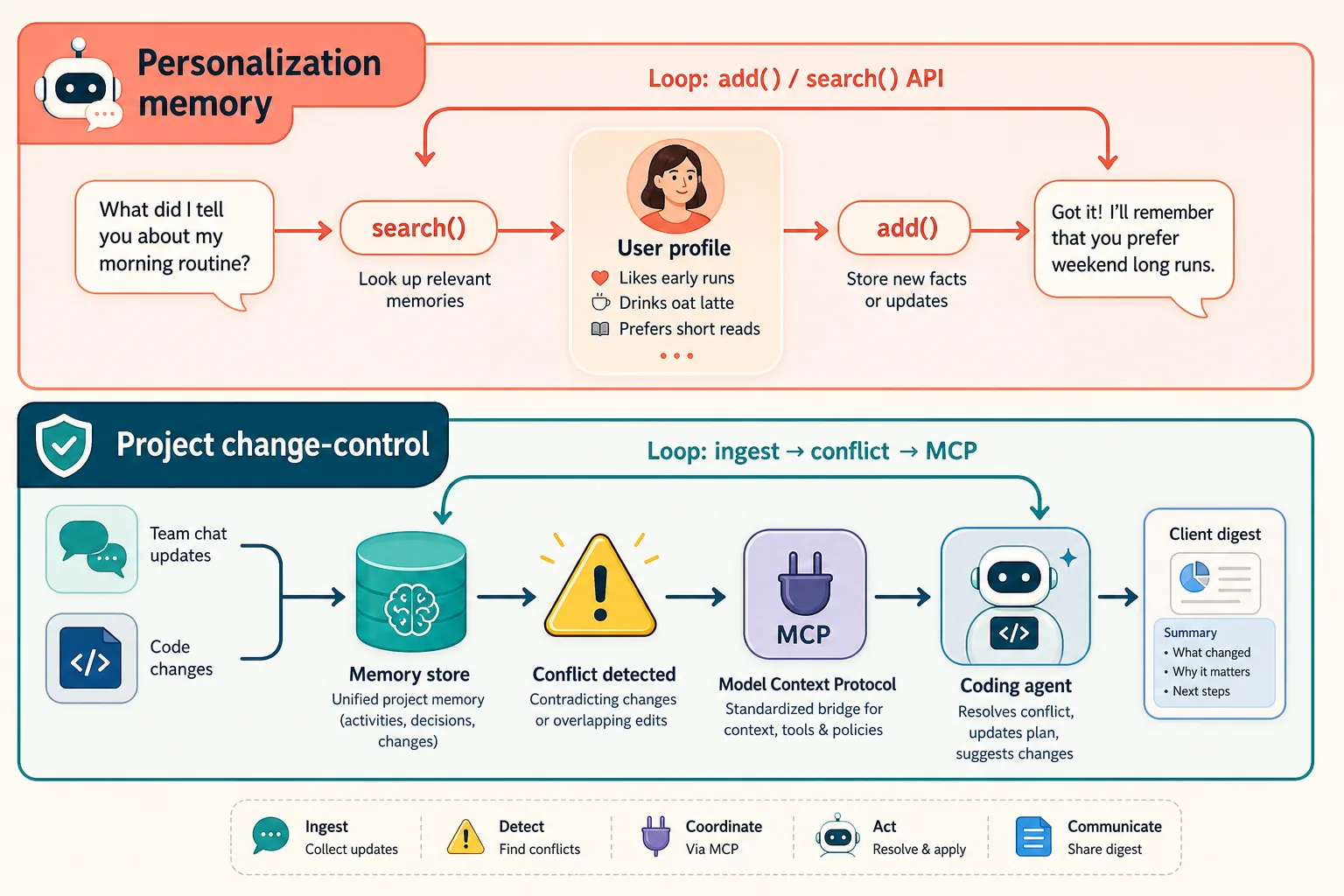
Mem0 is optimized for agent ↔ user memory. An agency’s expensive failure mode is different: a client constraint from three weeks ago, a decision in a PR, an agent that rewrites the auth service because nothing told it the freeze exists.
You can store project facts in Mem0 if you write them there. You still do not get:
- First-party ingestion of delivery tools into a shared project record (Slack and GitHub ship today; adding Linear, Notion, vaults, or other sources is the same connector pattern)
- Two-stage conflict detection as a risk signal for the owner
- Client-safe digests and a thin portal for people who never touch the SDK
- Human publish-to-truth for what becomes official (AI proposes, humans publish)
Mem0 can be a component inside an agent stack. It is not a change-control layer for the agency.
Capability snapshot
| Capability | Mem0 | Accord Book |
|---|---|---|
| Primary ingest | App / agent messages (and related APIs) | Work tools → project memory (Slack & GitHub shipped; more connectors low-friction) |
| Memory model | Extracted facts for users / agents | Provenance-tracked project decisions and constraints |
| Time / supersedes | Updates memories as new info arrives | Lineage and current-state retrieval for project truth |
| Conflict handling | Not the product focus | Deterministic candidates → LLM adjudication → owner |
| Human governance | App-level / enterprise admin | Owner arbitration; portal for team and client |
| Agent interface | SDK + MCP | MCP for existing coding agents (Cursor, Claude Code, …) |
| Hosting / data | Cloud and portable / BYOK options (per their site) | Single-org self-host; customer BYOK for LLMs |
| ICP | Builders of agents and AI apps | Boutique AI-native dev agencies (sweet spot ~20 engineers) |
When you should pick Mem0 anyway
Pick Mem0 when the product is an agent or AI app that needs durable personalization: healthcare companions, support desks, education tutors, CRM copilots. If your roadmap is “ship memory into our agent in a week,” Mem0 is aimed at that job. Do not buy Accord Book to remember a user’s timezone.
Where Accord Book fits
Accord Book’s loop is ingest → structure with provenance → conflict when new asks fight old decisions → distribute via digest and MCP. It sits beside the agents you already run; it does not replace them. Technical depth: hybrid retrieval, three-lane stack, cost framing.
We list Mem0 as a related product on directories for the same reason this post exists: buyers searching “AI memory” need a fork in the road, not a fake feature matrix.
Also in this series: landscape hub · vs Zep · vs Letta · vs Cognee · vs Notion · vs Obsidian · vs Linear
Product: Accord Book · Pilot