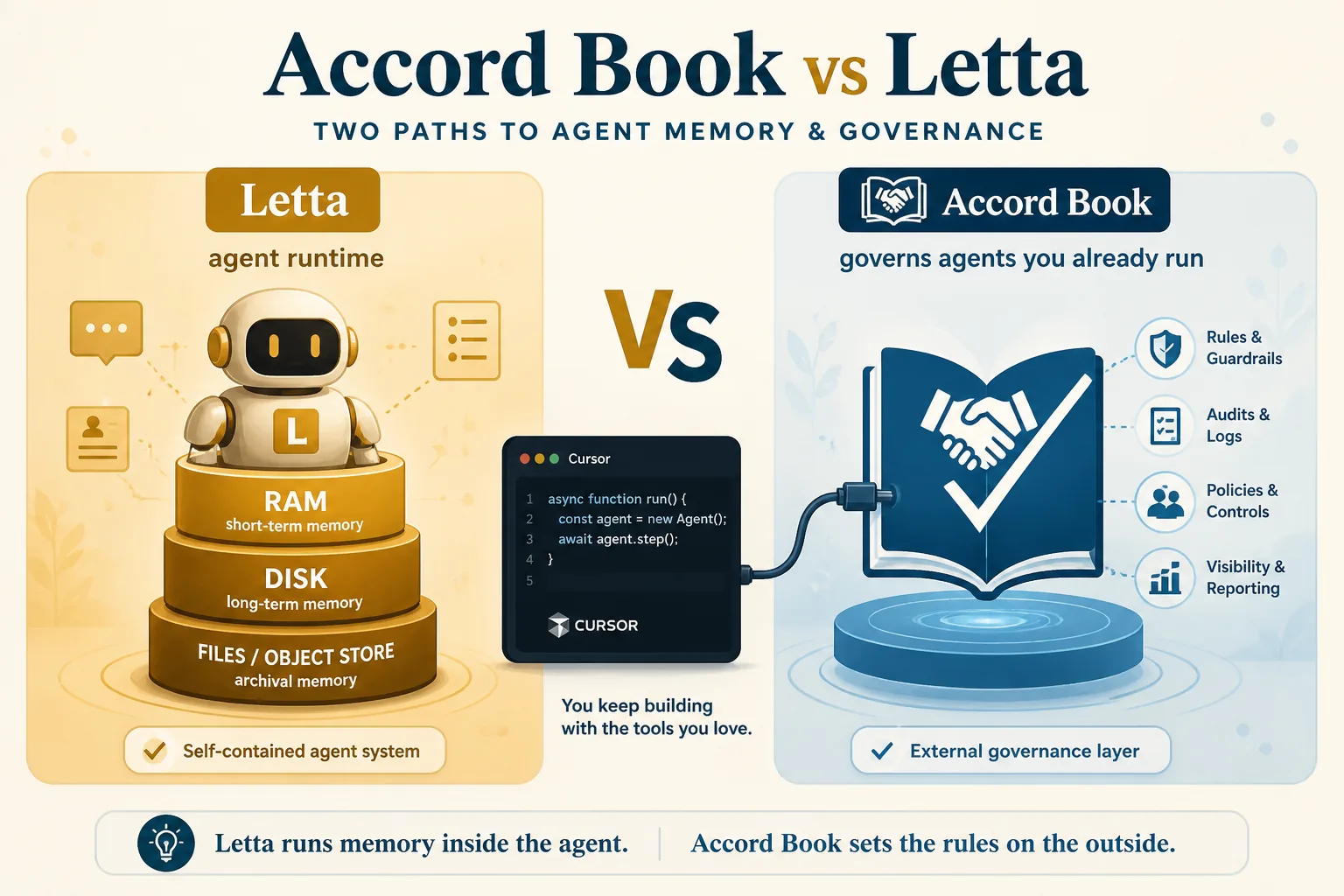
Letta wants the agent to be a learning system. Accord Book wants your existing coding agents to ask a governed project record before they act. One is a runtime. The other is a control plane for agencies.
What Letta is
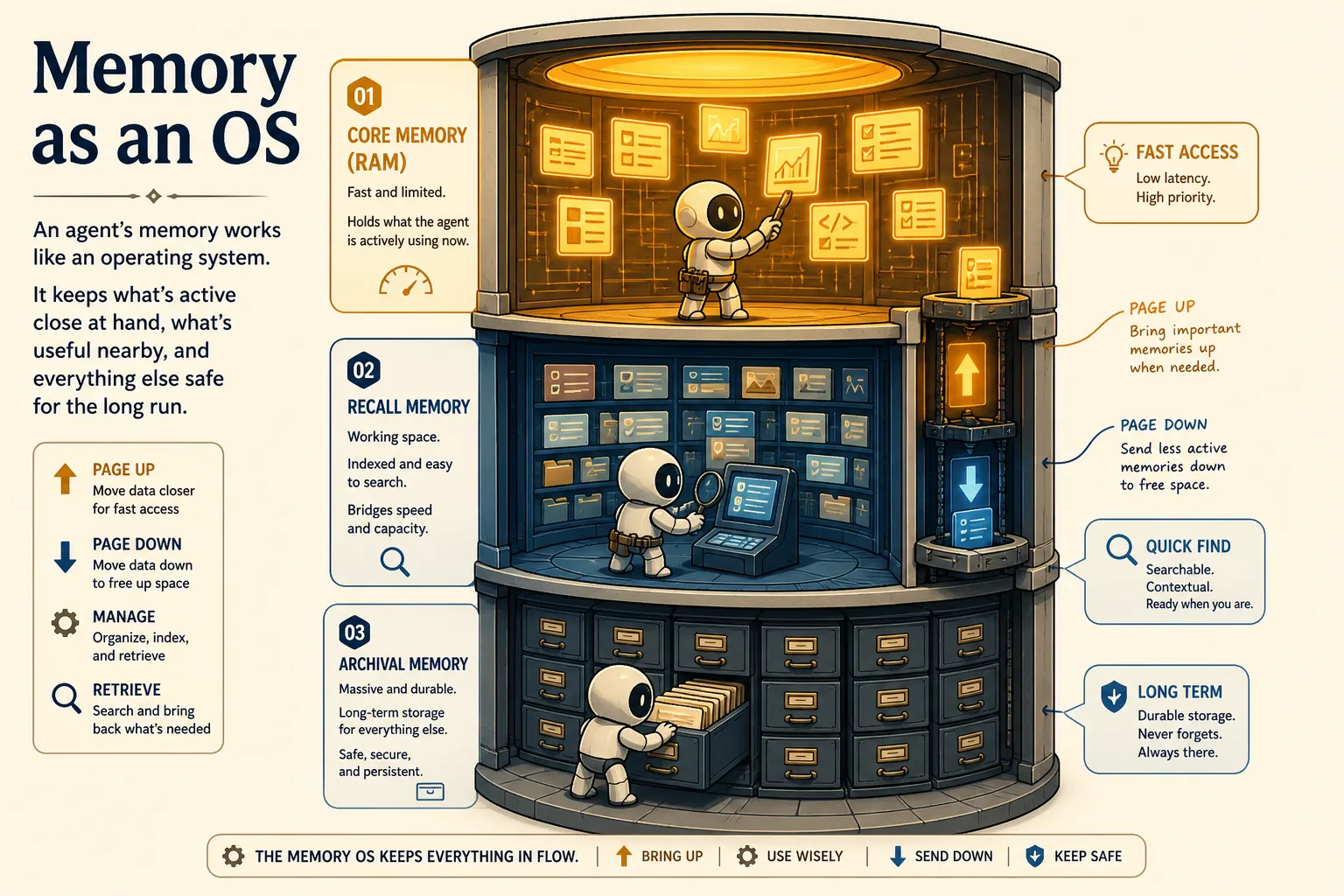
Letta is an AI research lab shipping software from the MemGPT lineage: virtual context management where the model treats memory like an operating system — core context as RAM, archival storage as disk, tools to page state in and out. As of August 2026 their site frames Letta Agent as a self-improving agent whose memory, identity, and capabilities evolve with experience. Research threads include sleep-time compute, context constitutions, and git-based context repositories. Code and related work appear under github.com/letta-ai.
Their best case: you are building a long-running digital coworker that must manage its own state for weeks, not bolt a search() call onto a chat loop.
Where Letta is strong
- Coherent research → product story: memory as OS, not as a side database.
- Agent-managed memory tiers — the model participates in what stays in context.
- Fit for teams that want to adopt a full agent stack, not only a store.
- Active research on continual learning and offline (“sleep-time”) reasoning.
- Case-study surface for production agent deployments (named on their site).
Where the agency job differs
Adopting Letta means adopting their agent model. Most small agencies already chose Cursor, Claude Code, or similar. Their pain is not “we lack an agent OS.” It is “the agents we have do not know the client’s constraints.”
Letta does not replace:
- Passive ingestion of work artifacts into a shared agency record (connectors start with Slack and GitHub; the wall to add another source is low)
- Conflict detection as an owner-facing risk signal (design notes)
- Client portal and digests for people outside the agent loop
- AI proposes, humans publish as the trust boundary
You can use Letta and still need a project memory layer. They are stacked categories, not substitutes.
Capability snapshot
| Capability | Letta | Accord Book |
|---|---|---|
| Primary ingest | Agent experience / tools / connected sources in their stack | Work tools → project memory (Slack & GitHub shipped; more connectors low-friction) |
| Memory model | OS-style tiers the agent manages | Provenance-tracked project memories |
| Time / supersedes | Agent-edited state and research on versioned context | Supersedes-aware project lineage |
| Conflict handling | Agent reasoning over its own memory | Explicit conflict pipeline → owner |
| Human governance | Operator of the agent product | Agency owner + team/client portal |
| Agent interface | You run (or are) the Letta agent | MCP into Cursor / Claude Code / MCP clients |
| Hosting / data | Their product / deployment model | Single-org self-host; customer LLM BYOK |
| ICP | Builders of stateful, learning agents | Boutique AI-native dev agencies (sweet spot ~20 engineers) |
When you should pick Letta anyway
Pick Letta when the product is a long-running agent that should learn and self-manage memory — research, digital employees, agent platforms. If your agency’s question is “which agent runtime should we standardize on?”, Letta is in that conversation. If the question is “how do we stop losing client decisions across the tools we already use?”, start elsewhere.
Where Accord Book fits
Accord Book is deliberately not another agent. Market naming even demotes “Q” to persona/codename so the product is not confused with Amazon Q-style assistants. The layer governs agents: constraints and decisions in, MCP context out, humans still publish truth. Landscape context: AI memory map.
Also in this series: landscape hub · vs Mem0 · vs Zep · vs Cognee · vs Notion · vs Obsidian · vs Linear
Product: Accord Book · Pilot