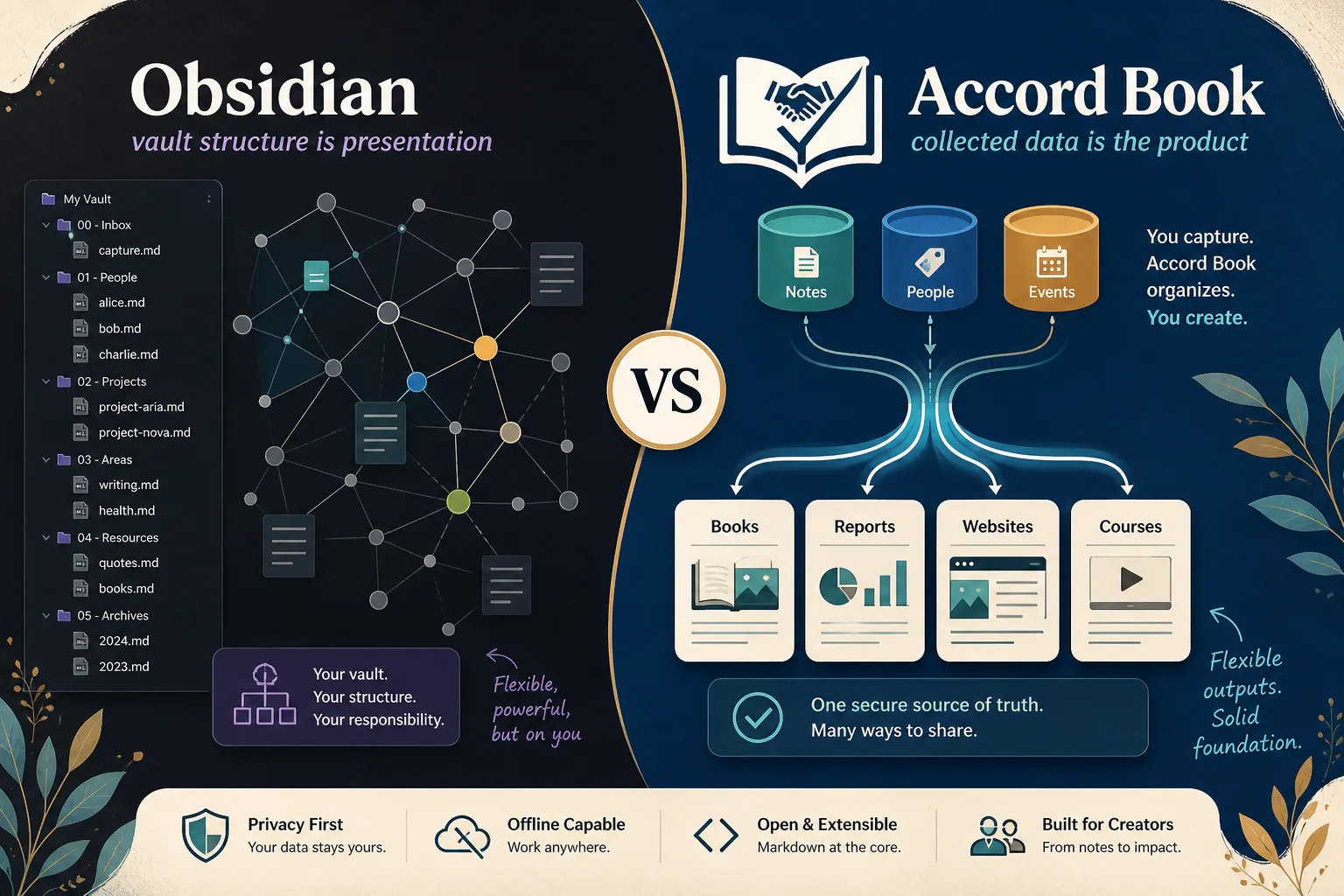
Many agencies run a shared Obsidian vault — often git-synced or via Obsidian Sync — as institutional memory. That is a serious practice. It is also easy to confuse how notes are arranged with what is being kept.
Accord Book starts from the opposite end: collect and keep the data; treat directories and graphs as views you can redo. Same knowledge class as Notion; Obsidian is local-first Markdown you own.
What Obsidian is
Obsidian is a free app for private notes stored as open files on your device. Links, graph view, Canvas, and thousands of plugins let teams shape a personal knowledge management system — or a team vault — without locking content into a proprietary page store. Optional Publish turns notes into a public wiki. Official help: help.obsidian.md.
Their best case: a vault the team trusts for years because the files are plain Markdown and the tool bends to how people think.
Where Obsidian is strong
- You own the files; offline access; no SaaS lock-in of the note body.
- Backlinks and graph make relationships visible for human browsing.
- Plugin ecosystem for almost any PKM workflow.
- Team collaboration is real (Sync, shared vaults, git) — not “personal only.”
- Excellent writing environment for ADRs, runbooks, and research notes.
The directory is presentation
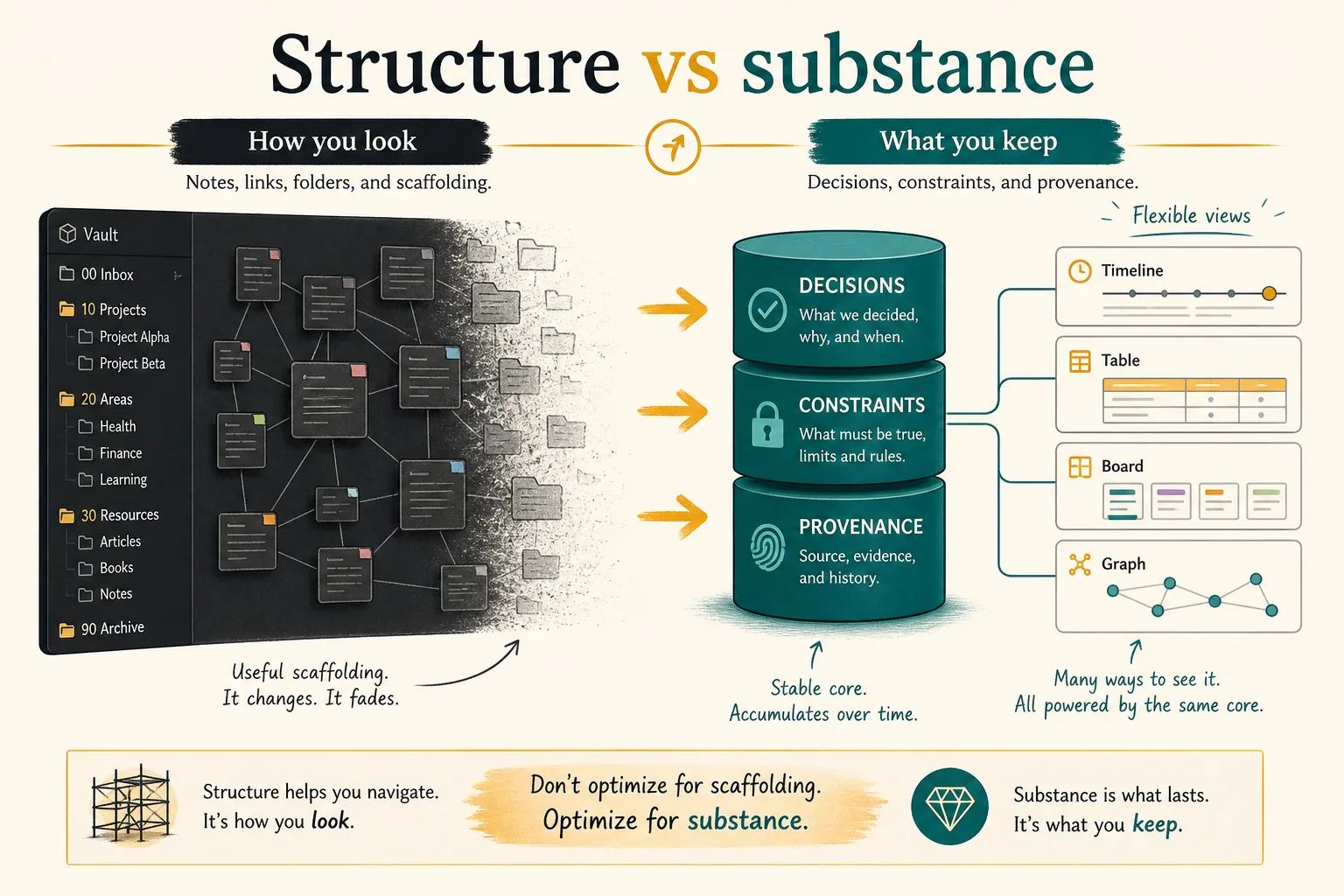
This is the core argument — and it applies even to a beautiful vault.
Folders, tags, MOCs, and the graph are a presentation layer. They help humans find and relate notes. They are not the asset. The asset is the data: the decision text, the constraint, the source, the actor, the timestamp, the supersession.
When the vault is the system of record, someone must:
- Notice the decision in chat, a ticket, or a PR
- Write it into a note
- File it under the right folder / link it into the right MOC
- Update it when the client changes their mind
- Hope the coding agent’s plugin reads the right file
When data is the center of the product, those steps invert. Work artifacts are ingested from whatever channels the agency already uses; memories are stored with provenance; presentation is rebuilt for each audience — team portal, client digest, MCP context for Cursor or Claude Code, admin inspection. You could even export a vault-style view later if you want Markdown on disk — or ingest an existing vault as another source. You should not need a new folder tree every time the audience changes.
Obsidian remains a great place to compose. Accord Book is for shops that need the record to accumulate from delivery, then be shown however each role needs.
Where else it stops for this ICP
- No first-class conflict pipeline as an owner risk signal (design)
- No client-safe portal with publish-to-truth (AI proposes, humans publish)
- Agent access is plugin/MCP onto a folder of notes, not a governed project memory API
Capability snapshot
| Capability | Obsidian | Accord Book |
|---|---|---|
| Primary ingest | Humans write Markdown | Work tools → project memory (Slack & GitHub shipped; more connectors low-friction — including vaults) |
| Memory model | Notes + links (+ plugins) | Provenance-tracked project memories |
| Time / supersedes | Manual edits / git history | Lineage and current-state retrieval |
| Conflict handling | Human process | Explicit conflict pipeline → owner |
| Human governance | Vault permissions / Sync | Owner arbitration; team/client portal |
| Agent interface | Plugins / community MCP | First-party MCP for coding agents |
| Hosting / data | Local files (+ optional Sync/Publish) | Single-org self-host; customer LLM BYOK |
| ICP | PKM and team knowledge vaults | Boutique AI-native dev agencies (sweet spot ~20 engineers) |
When you should pick Obsidian anyway
Pick Obsidian when the craft is thinking and writing: research gardens, engineer ADRs you want as files forever, a local-first culture that rejects hosted wikis. Keep the vault. Do not throw it away for Accord Book. Use Accord Book when the failure mode is agents and status calls losing the client agreement, not when the failure mode is “I need a better graph of my notes.”
Where Accord Book fits
Data first; views second. Ingest from the tools you already work in; conflict when asks drift; MCP and digests as presentations over the same record. Map: AI memory landscape. Cost framing: what Accord Book actually costs.
Also in this series: landscape hub · vs Mem0 · vs Zep · vs Letta · vs Cognee · vs Notion · vs Linear
Product: Accord Book · Pilot