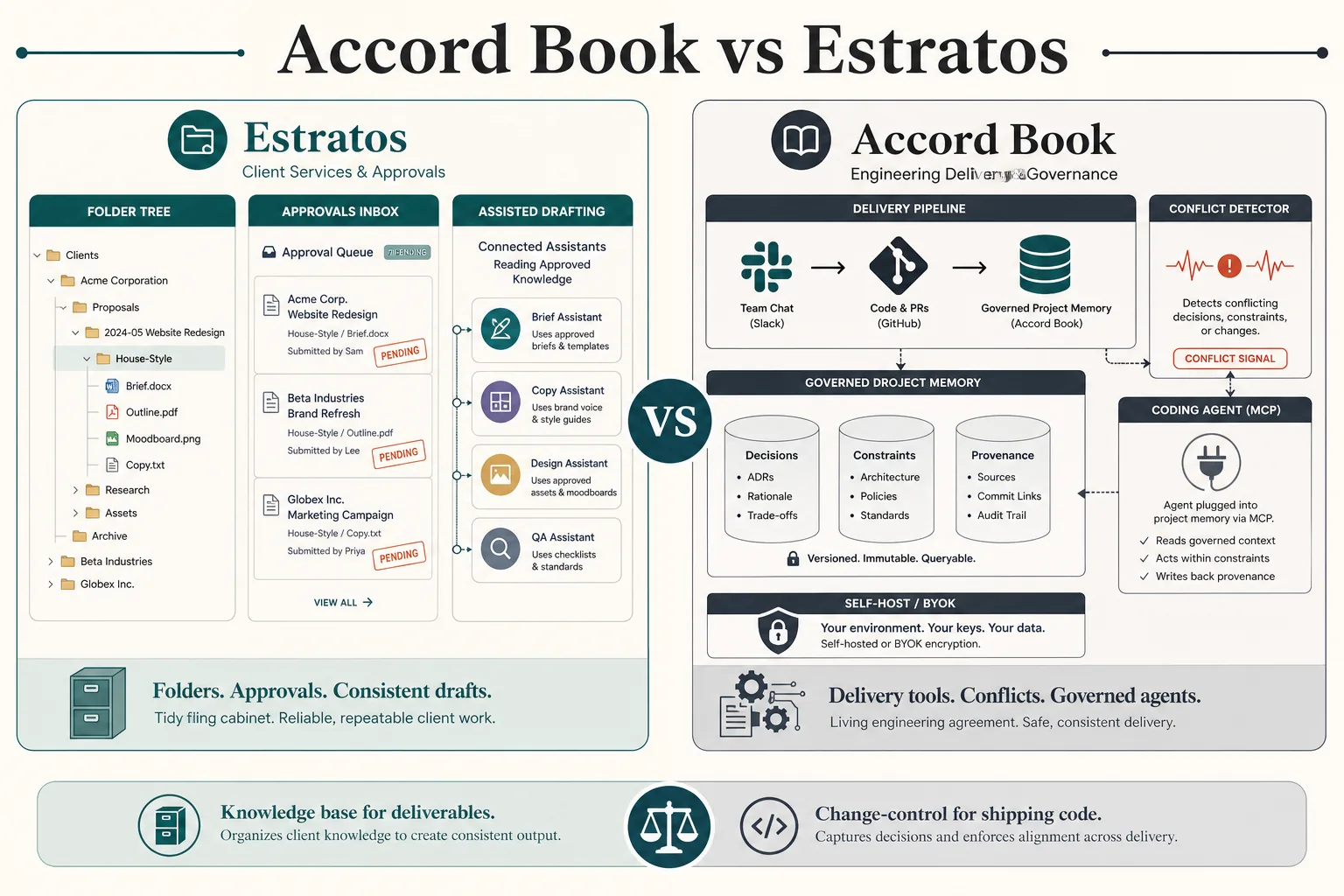
If you search “team memory for AI-assisted client work” today, Estratos is often the product-shaped answer on their homepage. Accord Book shows up when you already know the name — and targets the same phrase with team memory for AI-assisted client work. This post is for the agency owner comparing both — fairly, from public positioning as of August 2026.
What Estratos is
Estratos markets centralized team memory for AI-assisted client work: a shared knowledge base with company processes, client-specific information, and service-delivery instructions so AI-assisted work is faster and more consistent. Product story lives on estratos.ai.
Their public story emphasizes:
- Folder tree per client / service (e.g.
meridian-dental › proposals › house-style) - Memories formed per service, per client — editable in-app or proposed by agents mid-conversation
- Admin approval queue — proposed knowledge waits until an admin publishes it for the whole team
- Agent connections — assistants (Claude, OpenAI, Copilot per their site) read approved knowledge for the right client + service + firm combination
- Controls — row-level security per workspace, scoped agent sessions, audit log without exposing memory content, Markdown export
Vertical landing pages call out accounting & advisory, marketing agencies, and law firms. Access is invite-only (free while invite-only, per their site).
Where Estratos is strong
- Clear ICP for professional services — the homepage speaks in client folders, house style, and partner sign-off, not SDK docs.
- Human-in-the-loop by design — the review queue is the product, not an afterthought (same spirit as AI proposes, humans publish).
- Cross-cutting firm standards — shared folders (e.g.
firm-standards) plus per-client inheritance matches how consultancies think. - Low friction for chat-first AI — “connect an assistant and watch it answer from your knowledge” is an easy eval loop.
- Hosted convenience — no deployment story required to start (once you have an invite).
Approved knowledge vs delivery truth
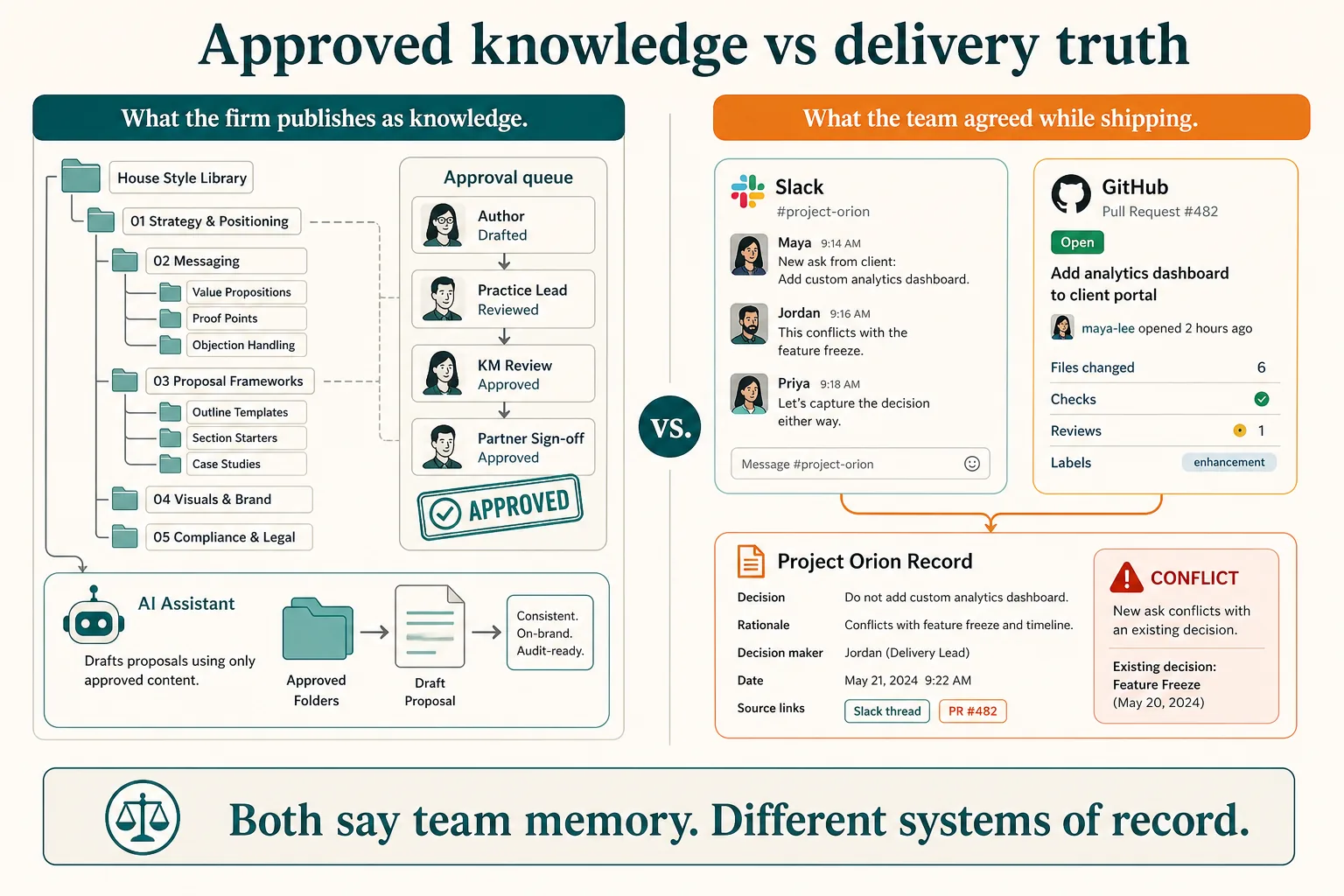
Accord Book is built for AI-native dev agencies — especially smaller boutique shops where the expensive failure is not “the proposal used hourly rates again” but:
- A scope decision buried in Slack three weeks ago
- An agent rewriting a module that was explicitly frozen
- Client engineering truth diverging from what the team ships
Both products say “team memory” and “approvals.” The split is what gets ingested first and what “current truth” means.
| Dimension | Estratos (public positioning) | Accord Book |
|---|---|---|
| Primary ingest | Knowledge entered or proposed in workflows; folder-oriented | Delivery tools → project record (Slack & GitHub shipped) |
| Unit of memory | Service × client folders, firm standards | Project-scoped decisions, constraints, provenance |
| Best AI surface | Connected assistants (Claude, OpenAI, Copilot per site) | MCP for coding agents (Cursor, Claude Code, …) + portal |
| Change-control | Approve/publish to knowledge base | Conflict detection → owner arbitration → Git-backed .q_context proposals |
| Client output | Correct first-time drafts from approved memory | Client-safe digests from project memory; owners approve before send |
| Hosting | Hosted SaaS, RLS isolation | Single-org self-hosted; customer BYOK |
| ICP emphasis | Accounting, marketing, law (professional services) | Dev agencies shipping with coding agents |
Estratos is closer to “approved knowledge base for AI-assisted client deliverables.” Accord Book is closer to “version control for project decisions across Slack, GitHub, and agents.”
When you should pick Estratos
Pick Estratos when:
- Your work product is documents and client-facing deliverables (proposals, advisory memos, campaigns) and the win is getting tone, fees, and sign-off blocks right the first time.
- You want a hosted team memory product with folders and an approval queue — not a deployment project.
- Your AI stack is assistant-centric (ChatGPT, Claude, Copilot) rather than IDE agents on a codebase.
Do not expect Estratos to replace Git-backed change-control or MCP preflight for a shipping engineering team — that is not the story on their site.
When Accord Book fits better
Pick Accord Book when:
- The client record must include commits, PRs, and Slack decisions, not only approved prose.
- You need conflict detection when new asks fight old constraints — before rework, not after a wrong draft.
- Self-hosting and BYOK are prerequisites for client data (common for dev shops).
- Coding agents need a governed MCP layer they query before editing production code.
Related framing: team memory for AI-assisted client work · why AI teams need a memory layer · what Accord Book actually costs.
Can you use both?
Conceptually yes — Estratos-like approval for client-facing knowledge and Accord Book for delivery truth. In practice most boutique agencies will pick one primary system of record first. If your pain is proposal house style, start with Estratos. If your pain is scope drift and agents ignoring last sprint’s decisions, start with Accord Book.
Also in this series: landscape hub · vs MemoryLake · vs TalkBase · vs Mem0 · vs Notion
Product: Accord Book · Pilot · Pricing